It starts with a song, doesn't it? That specific track playing as the car pulls up the gravel drive towards the imposing country house. In Kenneth Branagh's Peter's Friends (1992), the soundtrack – a glorious mixtape of Tears for Fears, The Pretenders, Queen, and Bruce Springsteen – isn't just background noise; it’s the pulsing heartbeat of nostalgia itself, summoning ghosts of youthful optimism before reality rudely barges in. Seeing this film again, perhaps slid from a worn cardboard sleeve into the VCR, feels like accepting an invitation to a reunion you’re both eager for and slightly dreading. You know these people, or people like them. You might even be one of them.
Ten Years On, Worlds Apart
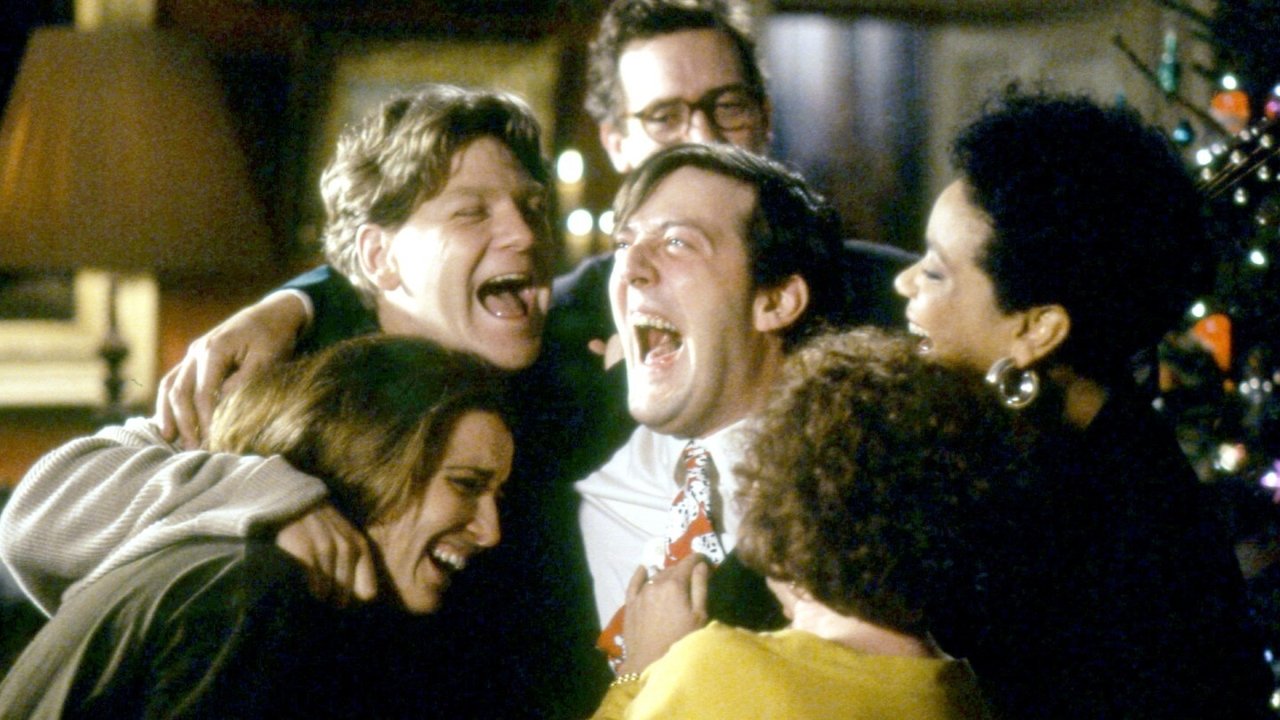
The setup is elegantly simple, echoing films like The Big Chill but carving its own distinctly British niche. Peter Morton (Stephen Fry), having recently inherited a sprawling estate from his father, invites his old university acting troupe pals for a New Year's Eve weekend, a decade after their last hurrah. We meet them as they arrive: Andrew (Kenneth Branagh), now a struggling writer in Hollywood, married to ambitious sitcom star Carol (Rita Rudner, who also co-wrote the screenplay with her husband Martin Bergman); glamorous costume designer Sarah (Alphonsia Emmanuel) bringing along her new, much-married boyfriend Brian (Tony Slattery); Roger (Hugh Laurie) and Mary (Imelda Staunton), jingle writers whose marriage is fraying under the weight of a shared tragedy; and the wonderfully grounded Maggie (Emma Thompson), harbouring a long-held torch for Peter.
What unfolds isn't driven by complex plot mechanics, but by the intricate, often messy interplay between characters who know each other perhaps too well. The old dynamics snap back into place almost instantly – the in-jokes, the rivalries, the shared history – but now layered with a decade's worth of compromise, disappointment, and adult anxieties. It’s a film less about what happens and more about what is revealed in the spaces between conversations, in the awkward silences and forced laughter.

A Cast Born From Friendship
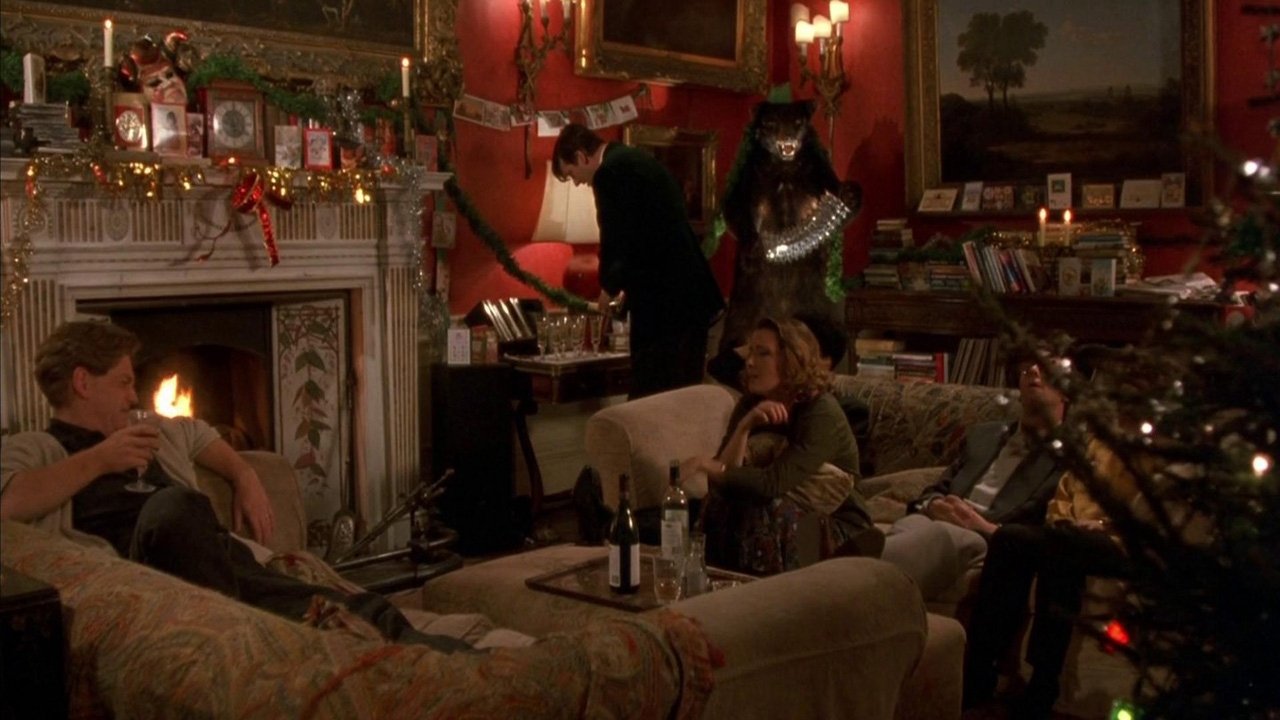
The magic, undeniably, lies in the ensemble. This wasn't just stunt casting; many of these actors – Branagh, Thompson (married at the time), Fry, Laurie, Staunton – shared genuine history, famously coming up through the Cambridge Footlights revue. That real-life familiarity bleeds onto the screen, lending an almost unnerving authenticity to their interactions. You believe these people shared formative years, that their bonds and barbs have deep roots. It's fascinating trivia that the film was shot at Wrotham Park in Hertfordshire, a location often used for stately home settings, providing the perfect backdrop for Peter’s inherited wealth and the contained drama – a gilded cage for their simmering issues. Branagh, directing himself and his friends, clearly understood how to harness this collective energy.
Emma Thompson is, as ever, luminous. Her Maggie is the film's soulful centre, her quiet yearning and clear-eyed observations providing a crucial anchor. Watching her navigate her unrequited feelings for Fry's Peter, who remains frustratingly obtuse yet deeply affectionate, is a masterclass in understated emotion. Fry himself delivers a performance of carefully modulated melancholy, hinting at a deeper reason for this reunion beyond simple nostalgia. His Peter is witty, charming, yet carries a palpable weight. The partnership of Hugh Laurie and Imelda Staunton as the grieving couple is quietly devastating, their attempts at normalcy constantly undermined by unspoken pain. Their storyline tackles profound loss with a sensitivity rare in mainstream film. And then there's Branagh and Rudner, embodying the slightly desperate edge of showbiz ambition, their marital friction providing both comic relief and sharp commentary on career pressures.
More Than Just a Posh Get-Together
While the film revels in witty banter and some genuinely funny moments (often stemming from the culture clash between the Brits and Rudner's American character, or Tony Slattery's hilariously inappropriate interloper), it doesn't shy away from darker undercurrents. The script, penned by Rudner and Bergman, deftly balances humour with pathos. It asks uncomfortable questions about the paths we choose, the dreams we abandon, and the masks we wear, even – perhaps especially – around those who knew us when we were young and supposedly fearless. What happens when the potential you felt brimming within your group curdles into regret or settles into mundane compromise?
One delightful piece of trivia: Rita Rudner, primarily known as a stand-up comedian, tailored her character Carol to fit her own comedic persona and experiences navigating Hollywood. This adds another layer of meta-commentary to the proceedings. The film itself had a modest budget and achieved respectable success ($4 million at the US box office), finding its audience among those who appreciated its blend of humour, heart, and recognisable human frailty. It wasn't a blockbuster, but like a cherished mixtape, it struck a chord.
There's a moment, a revelation late in the film (slight spoiler warning) concerning Peter's true reason for gathering his friends, that shifts the tone irrevocably. It re-contextualizes everything we've seen, forcing both the characters and the audience to confront mortality and the preciousness of connection. It’s handled with surprising grace, avoiding cheap sentimentality.
The Verdict
Peter's Friends isn't flashy. It doesn't rely on dramatic twists every ten minutes. Its power lies in its quiet observations, its lived-in performances, and its resonant themes. Watching it now, decades later, feels strangely comforting, like reconnecting with old acquaintances – you see the lines etched by time, the changes wrought by life, but the core of who they are remains recognisable. It captures that specific early 90s moment, bridging the gap between youthful idealism and the sobering realities of adulthood, all set to a killer soundtrack.
Rating: 8/10 - This score reflects the film's exceptional ensemble cast, its authentic portrayal of long-term friendships, and its skillful blend of comedy and drama. While sometimes compared to The Big Chill, it possesses a unique British sensibility and emotional depth anchored by standout performances, particularly from Thompson and Fry. It earns its emotional moments honestly.
Peter's Friends remains a poignant, funny, and deeply human film that reminds us that while time changes everything, the echoes of shared history, for better or worse, always linger. What conversations, left unsaid for years, might surface if your own university friends gathered for one weekend?