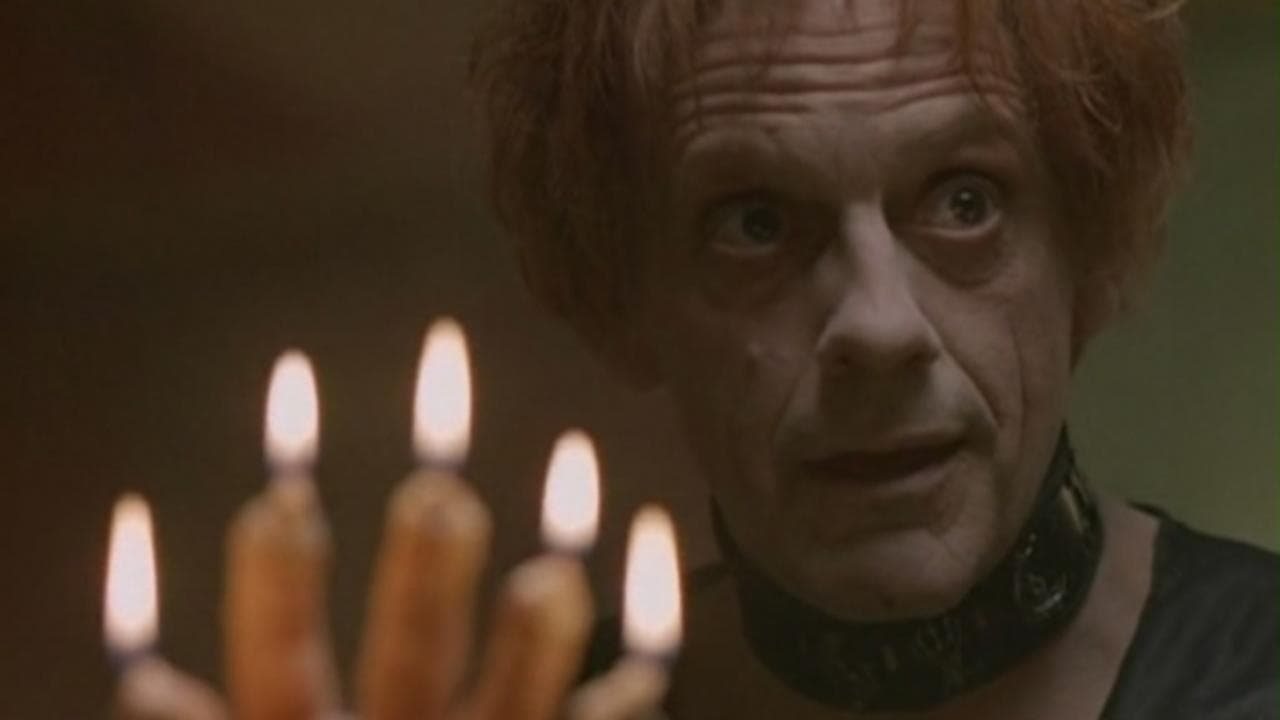
The static fades, the tracking lines waver for just a moment, and then his face fills the screen – gaunt, intense, framed by a shock of wild white hair. Christopher Lloyd, far from the flux capacitor, stares out from the cathode ray glow, not as a zany scientist, but as Aaron Quicksilver, a travelling curator of the uncanny. He’s our guide down the Quicksilver Highway (1997), a lonely road paved with tales sourced from the twisted imaginations of Stephen King and Clive Barker. This isn't your typical highway rest stop; it's a place where the mundane curdles into the monstrous, broadcast directly into our living rooms one Tuesday night in May '97 on the Fox Network.
Your Guide to the Grotesque
Helmed by Mick Garris, a director already well-versed in translating Stephen King for the screen with works like Sleepwalkers (1992) and the epic The Stand (1994) miniseries, Quicksilver Highway aimed to capture the spirit of classic horror anthologies. Lloyd's Quicksilver, a character Garris envisioned as a kind of macabre showman, serves as the connective tissue. He’s less EC Comics Cryptkeeper, more wandering desert mystic stumbling upon travellers in distress, offering stories as cautionary warnings. Lloyd commits fully, lending a theatrical gravity to the framing segments, his piercing eyes suggesting he’s seen far more than he’s letting on. It’s a performance that anchors the film's sometimes uneven journey, hinting at the larger, darker world these stories inhabit. Garris, who had fostered relationships with both King and Barker, clearly hoped this project – essentially adapting King's "Chattery Teeth" and Barker's "The Body Politic" – might blossom into a full series. Alas, it remained a one-off special, a curious artifact of 90s TV horror ambition.
Chattering Nightmares
First stop: "Chattery Teeth". Pulled from King's Nightmares & Dreamscapes collection, this segment feels distinctly like classic King territory. Raphael Sbarge plays Bill Hogan, a weary travelling salesman who picks up a desperate-looking hitchhiker after impulsively buying a pair of oversized, metal wind-up chompers from a dusty roadside curio shop. King excels at finding horror in the mundane, and the "Chattery Teeth" themselves are a prime example. They’re ridiculous, novelty items imbued with a strange, protective menace. When the hitchhiker inevitably turns violent, the tension ratchets up effectively, culminating in a bizarrely satisfying, if slightly goofy, display of practical effect carnage. Seeing those oversized teeth clatter across the dashboard, fulfilling some grim purpose, felt uniquely unsettling back then. It captured that specific King flavour – ordinary objects becoming conduits for extraordinary, often violent, events. You have to wonder how many takes it took to get those teeth walking just right via puppetry and wire work; the effect is simple, yet oddly chilling in its single-mindedness.
Hands Off!
The highway then takes a sharp turn into the territory of Clive Barker with "The Body Politic," adapted from his legendary Books of Blood. This is where the film embraces visceral body horror, albeit filtered through the lens of 90s broadcast standards. Matt Frewer (forever etched in our minds as Max Headroom) stars as Dr. Charles George, a surgeon whose own hands decide they've had enough of servitude and spark a full-blown revolution against their owner – and eventually, all of humanity. It's a fantastically grotesque concept, pure Barker, blending surgical precision with primal rebellion. Frewer throws himself into the physical performance, wrestling with his own mutinous appendages in scenes that are both horrific and darkly comic. Bringing this tale to life required considerable ingenuity, particularly in depicting the liberated hands scurrying, plotting, and wielding scalpels. The practical effects team relied heavily on puppetry, forced perspective, and actors literally performing as hands under tables or behind props – a testament to the creativity often born from TV movie limitations. Did the sight of those skittering plastic hands genuinely unnerve you back in '97, or was it the sheer audacity of the concept that stuck?
Made-for-TV Macabre
Watching Quicksilver Highway today is an exercise in appreciating the specific constraints and charms of its era. The pacing can feel a little slack compared to modern horror, beholden to commercial break structures. The budget limitations are occasionally apparent, particularly in some of the effects work that hasn't aged as gracefully as others. Yet, there's an undeniable sincerity to the production. Garris clearly respects the source material, striving to capture the distinct flavours of both King's grounded dread and Barker's more fantastical, flesh-bound terrors. The score attempts to weave an atmospheric thread, and the production design effectively creates the lonely, slightly surreal roadside environments where these nightmares unfold. It may lack the polish of a theatrical feature, but it possesses the earnest, slightly rough-around-the-edges appeal that defined so much genre television of the time. I distinctly remember catching this late one night, the glow of the CRT casting long shadows, and feeling that specific thrill of discovering something weird and unsettling tucked away in the TV schedule.
Rating & Final Road Stop
Quicksilver Highway is a fascinating snapshot of 90s TV horror, an ambitious attempt to bring two masters of the genre together under one banner. While hindered somewhat by its format and budget, strong performances from Christopher Lloyd and Matt Frewer, the inherent power of the King and Barker source stories, and moments of genuinely creepy practical effects make it a worthwhile detour for retro horror fans. It doesn't quite reach the heights of the best anthology films, but its earnest strangeness and commitment to its bizarre premises earn it a nostalgic charm.
Rating: 6/10
It might not be a pristine superhighway, but for fans nostalgic for the days when horror anthologies could still surprise you on late-night television, Quicksilver Highway offers a bumpy but memorable ride down a road less travelled. It stands as a testament to a time when networks were still willing to take a chance on something genuinely odd.