It wasn't every day you saw a lumbering World War II bomber stuffed with farm animals gracing the poster at the local video store. Yet, there it was: The Last Flight of Noah's Ark, a 1980 Disney offering that promised adventure with a decidedly quirky twist. It might not have roared like Star Wars or charmed like E.T., but this film, nestled somewhere between the studio's classic era and its later animation renaissance, holds a peculiar charm, like finding a slightly dusty but fondly remembered toy in the attic.
### An Ark Unlike Any Other
The premise itself feels like something cooked up during a particularly inventive rainy afternoon: Elliott Gould, bringing his signature laid-back, slightly cynical energy (a fascinating choice for Disney at the time, fresh off more adult fare like MASH*), plays Noah Dugan, a down-on-his-luck pilot drowning in debt. His unlikely lifeline? A job flying a dedicated, perhaps slightly naive, missionary, Bernadette Lafleur (the wonderful Geneviève Bujold, known for heavier roles like Anne of the Thousand Days), along with her menagerie of farm animals, to a remote South Pacific island. Oh, and did we mention the aircraft is a gigantic, war-weary B-29 Superfortress, affectionately (or perhaps ironically) nicknamed "Noah's Ark"? If that wasn't enough cargo, two young orphans, Bobby and Julie (including a very young Ricky Schroder, already a star after The Champ), sneak aboard for the ride. It’s a setup ripe for chaos, charm, and maybe a little bit of airborne animal husbandry.
### Island Adventures and Unexpected Encounters
Directed by Charles Jarrott, who had previously worked with Bujold on Anne and directed other Disney live-action features like Escape from the Dark, the film shifts gears when, inevitably, the overloaded B-29 is forced down onto an uncharted island during a storm. The crash landing itself is a moment of classic movie peril, but it’s what comes after that truly defines the film. Stranded, our unlikely crew discovers they aren't alone. The island is inhabited by two aging Japanese soldiers who, shades of Hell in the Pacific but much gentler, never got the memo that World War II ended decades ago. This encounter provides the film’s central conflict and, ultimately, its heartwarming core, as mistrust slowly gives way to cooperation. The lush Hawaiian scenery, with filming taking place on Kauai, provides a beautiful, if perilous, backdrop to their predicament.
### From Bomber to Boat: A Feat of Practical Magic
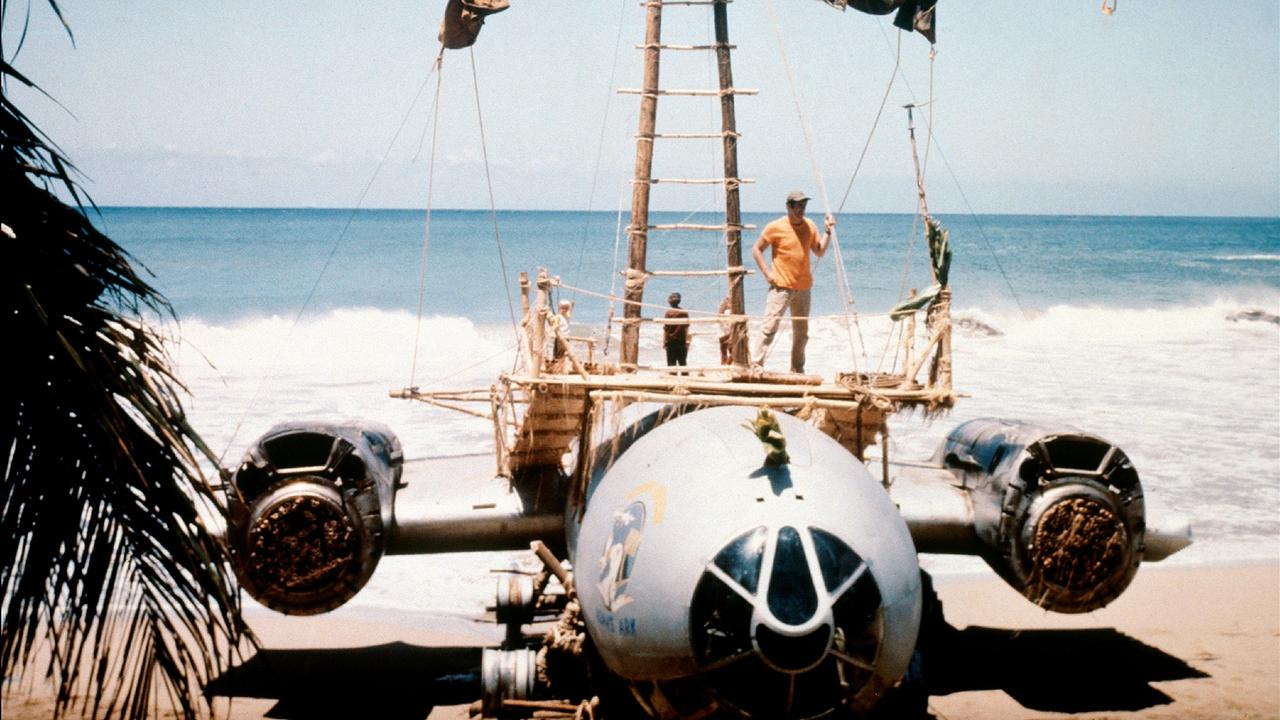
What always stuck with me about The Last Flight of Noah's Ark was the sheer audacity of their survival plan: converting the wrecked fuselage of the B-29 into a seaworthy vessel. In an era before CGI rendered such transformations commonplace, this was a testament to good old-fashioned practical effects and production design. Watching them painstakingly salvage parts, rig sails, and essentially build a boat out of a plane felt like a grand, imaginative project – the kind of thing you might dream up building with LEGOs or cardboard boxes in the backyard.
Retro Fun Fact: That wasn't just any old plane, either. The filmmakers used a genuine, airworthy Boeing B-29 Superfortress known as "Fertile Myrtle" (Serial 44-62049) for the flying sequences! Seeing that massive piece of aviation history actually take to the skies adds a layer of authenticity that’s hard to beat. Sadly, like many unique movie props, the aircraft was reportedly scrapped after filming concluded. Knowing it was a real, functional bomber makes its transformation feel even more remarkable.
### Heartfelt Charm, Modest Flight Path
Let's be honest, The Last Flight of Noah's Ark isn't groundbreaking cinema. The plot hits familiar beats of survival and found family, and the humor is gentle, leaning heavily on the fish-out-of-water scenarios (both human and animal). Gould plays against his usual type, softening his edges as the grumpy pilot who finds his heart. Bujold radiates warmth and quiet strength, while Schroder delivers the earnestness expected of a child star of the era. The film performed modestly at the box office, pulling in around $11 million domestically against a budget likely in the $6-8 million range, perhaps explaining why it sometimes feels like a half-remembered dream from the Disney back catalogue. Critics at the time were somewhat mixed, acknowledging its charm but finding it a bit lightweight.
But dismissing it for its simplicity misses the point. This Disney 80s movie embodies a certain kind of wholesome, earnest adventure that feels increasingly rare. It’s a story about resourcefulness, overcoming differences, and the quiet heroism of ordinary people (and animals!) in extraordinary circumstances. There's an innocence to it, a belief in cooperation and ingenuity, that feels genuinely comforting, especially viewed through a nostalgic lens.
Rating: 6/10
This rating reflects the film's undeniable heart, unique premise, and impressive practical work with the B-29, balanced against its somewhat predictable plot and dated pacing. It's not a masterpiece, but it’s a thoroughly pleasant and imaginative family adventure that earns its charm. It might be a slightly bumpy ride, but The Last Flight of Noah's Ark ultimately delivers its passengers (and viewers) to a place of gentle warmth and quirky adventure – a perfect slice of early 80s Disney earnestness, best enjoyed with a forgiving heart and maybe a fondness for repurposed aircraft.