It arrived in video stores on a wave of expectation, didn't it? Nestled amongst the action flicks and comedies on those tall metal shelves, the cover art for Dying Young (1991) promised something else entirely: glossy heartache, star power, and the potent emotional pull of Julia Roberts at the absolute peak of her early fame. Fresh off the colossal success of Pretty Woman (1990), Roberts taking on a serious romantic drama felt significant, a deliberate step. But revisiting it now, decades removed from that initial buzz, what lingers beyond the high-concept premise and the undeniably effective tearjerker moments?

A Gilded Cage by the Sea
The setup is pure Hollywood high-concept: Hilary O'Neil (Julia Roberts), a vibrant young woman from the "wrong side of the tracks" with a history of bad choices, answers a cryptic classified ad. She finds herself interviewing for a private nursing position in the opulent San Francisco home of Victor Geddes (Campbell Scott), a wealthy, intelligent, and intensely private young man secretly undergoing brutal chemotherapy for leukemia. He needs a caregiver, someone unaware of his illness, to accompany him to a secluded house on the picturesque, foggy Mendocino coast for his treatment cycles. It's a premise fraught with dramatic potential – the collision of worlds, the forced intimacy, the secret hanging heavy in the coastal air.
Director Joel Schumacher, a filmmaker never shy about visual flair (think St. Elmo's Fire or The Lost Boys), certainly leans into the aesthetics. The coastal house is stunning, isolated, a beautiful prison where Victor confronts his mortality and Hilary confronts her own life. Schumacher and cinematographer Juan Ruiz Anchía bathe the film in a soft, sometimes melancholic light, emphasizing the beauty that exists alongside the pain. It’s a specific kind of early 90s gloss – tasteful, expensive-looking, occasionally bordering on the overly stylized for such grim subject matter, but undeniably atmospheric. You can almost feel the damp sea air and the chill that has nothing to do with the weather.

Beyond America's Sweetheart
The film rests squarely on the shoulders of its leads. For Julia Roberts, this was a chance to prove her range beyond that incandescent smile. While Hilary shares some of the working-class charm and vulnerability seen in her Pretty Woman role, there’s a deeper weariness here, a yearning for stability. Roberts conveys Hilary’s initial unease, her growing compassion, and the complex mixture of love and fear that develops. It wasn't a radical departure, perhaps, but she grounds the sometimes-saccharine script with sincerity. It’s easy to forget, given her subsequent decades of stardom, just how luminous and captivating she was during this specific period. Reportedly commanding an $8 million salary for the role – a staggering sum back then, testament to her post-Pretty Woman bankability – the pressure was immense.
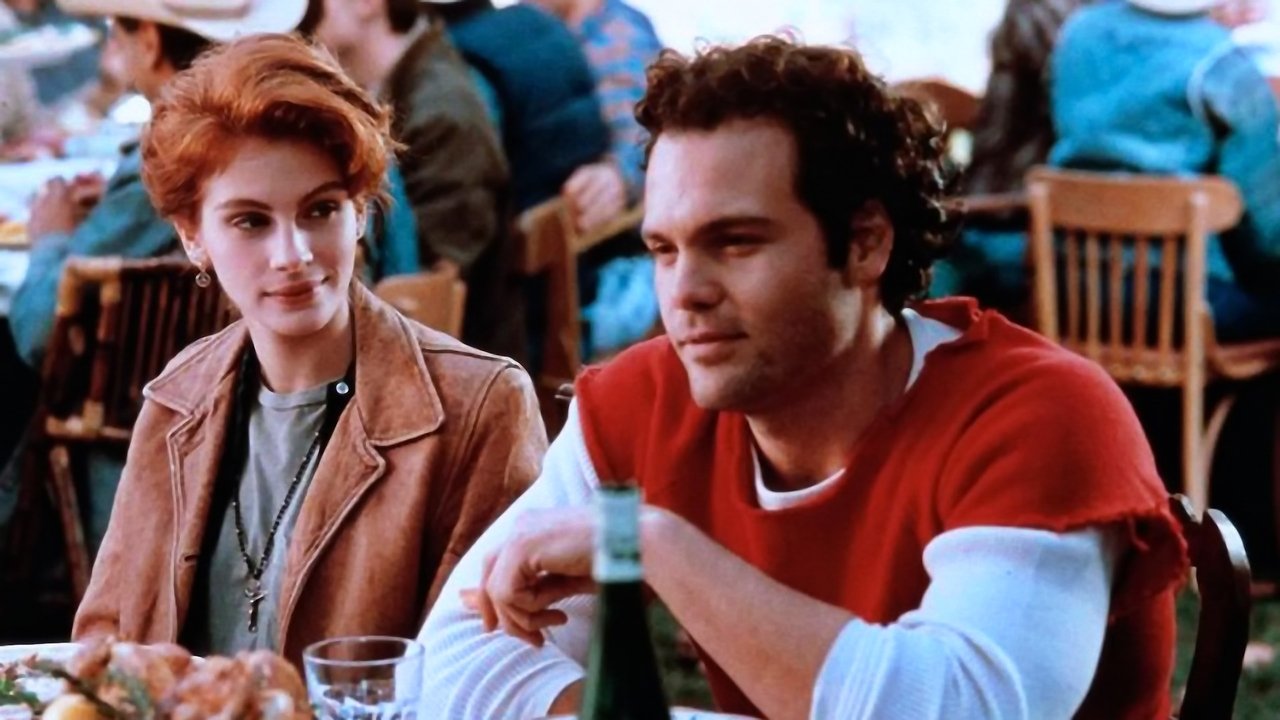
Opposite her, Campbell Scott delivers a performance of quiet intensity and physical commitment. Playing Victor required more than just intellectual brooding; Scott convincingly portrays the harrowing physical toll of aggressive cancer treatment – the fatigue, the pain, the vulnerability. It's a nuanced performance that avoids easy pity, capturing Victor's fierce intelligence, his frustration, and the gradual cracking of his cynical facade as he lets Hilary in. Their chemistry is gentle, built on shared vulnerability rather than fiery passion, which feels appropriate for the circumstances. And let's not forget Vincent D'Onofrio as Gordon, Hilary’s supportive, slightly goofy best friend back in the city, offering moments of warmth and grounding reality checks.

The Sound of Sentiment
You can't discuss Dying Young without mentioning the music. Kenny G's instrumental theme became absolutely ubiquitous, topping charts and defining the film's mood for millions. For better or worse, that smooth soprano saxophone became synonymous with the movie's brand of earnest emotion. It’s undeniably effective in tugging at the heartstrings, but revisiting it now, does that pervasive score sometimes feel like it's doing the heavy lifting, smoothing over complexities in favor of straightforward sentiment?
The film certainly walks a fine line. Based on Marti Leimbach's novel, Richard Friedenberg's script aims for profound truths about love, sacrifice, and facing death, but occasionally dips into predictable melodrama. Critics at the time were decidedly mixed, often calling it out for being manipulative or overly sentimental. Yet, audiences often connected with it. I remember renting this on VHS, probably more than once, drawn in by Roberts and the promise of a good cry. There’s an undeniable pull to stories that grapple with life-and-death stakes intertwined with romance, however idealized the portrayal might be. The core question it poses – can love truly flourish under the shadow of imminent loss? – remains potent.
Illness, Idealization, and Lasting Impressions
Watching Dying Young today prompts reflection. Does the depiction of illness feel authentic, or is it romanticized through the Hollywood lens? It certainly presents a more sanitized version of cancer treatment than we might see now, focusing more on the emotional rather than the truly visceral aspects. Yet, Scott’s performance lends it credibility. The central relationship, while sweet, perhaps simplifies the immense, often unglamorous burden of caregiving.
Still, there's an earnestness to the film that resonates. It captures a specific early 90s sensibility – a belief in the transformative power of love, presented with lush visuals and heightened emotion. It’s a time capsule of Julia Roberts solidifying her superstar status, of Joel Schumacher applying his stylish signature to drama, and of a type of romantic tearjerker that feels less common today. It may not be a complex masterpiece, but its emotional core, powered by committed performances, still flickers.

Rating: 6/10
This score reflects a film that succeeds largely due to its star power and its effective, if sometimes heavy-handed, grasp on emotion. The performances, particularly Campbell Scott's, provide a necessary anchor, and Schumacher's direction ensures it looks beautiful. However, the script occasionally succumbs to sentimentality, and the pervasive score can feel dated. It earns its 6 as a well-crafted example of its specific time and genre – a notable entry in the early 90s romance canon and a key moment in Julia Roberts's ascent, even if it doesn't quite transcend the tearjerker formula.
What lingers most isn't necessarily the plot's tragic trajectory, but the quiet moments of connection against the backdrop of that beautiful, lonely coast – a testament to the enduring appeal of finding light, however fleeting, in the darkest of circumstances.