There's a peculiar kind of dissonance that clings to certain films rediscovered from the video store era, isn't there? Sometimes it's the clash of outdated effects with genuinely potent ideas, other times it's a tonal tightrope walk that feels almost audacious decades later. Gérard Jugnot's 1994 film Casque bleu (released in some English-speaking territories as Blue Helmet) fits firmly into that latter category, presenting a premise that sounds almost jarring on paper: a romantic comedy-drama unfolding against the grim backdrop of the Yugoslav Wars. Yet, revisiting it now evokes a surprising warmth and a thoughtful reflection on finding humanity in the unlikeliest, most harrowing of circumstances.
From Salon to Sarajevo (Almost)
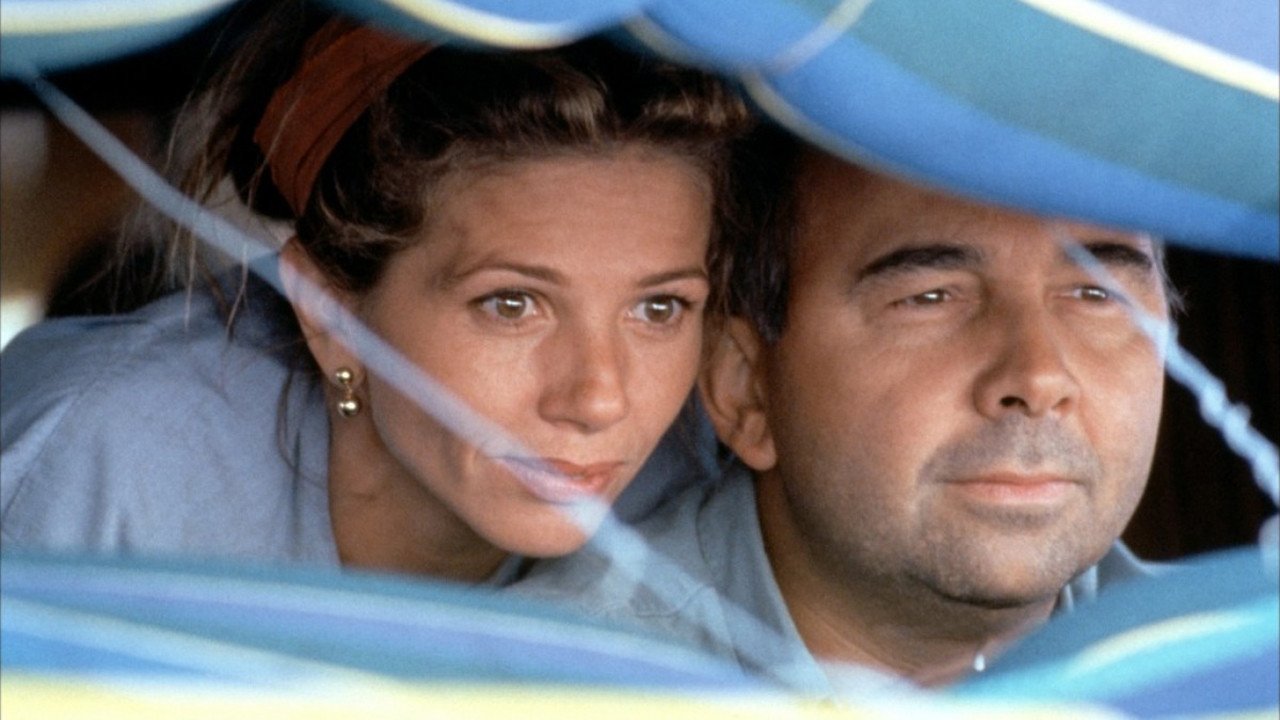
The setup introduces us to Patrick (Gérard Jugnot), a slightly fussy, comfortably middle-aged Parisian hairdresser whose biggest concern seems to be the day-to-day running of his salon. His life takes a sharp, unexpected turn when he impulsively follows his estranged wife, Alicia (Victoria Abril), a fiery and determined journalist, to war-torn Yugoslavia where she's covering the conflict. Patrick, completely unprepared and out of his depth, finds himself navigating the dangers and absurdities of a UN peacekeeping zone ('Casque bleu' refers to the blue helmets worn by UN peacekeepers), hoping to win back Alicia while simply trying to stay alive. It's a classic fish-out-of-water scenario, but transplanted into an environment far removed from the usual comedic settings.
Jugnot's Delicate Balance
What makes Casque bleu fascinating is seeing Gérard Jugnot operate on both sides of the camera. Primarily known in France as a core member of the legendary comedy troupe Le Splendid (think Les Bronzés (1978) or Santa Claus is a Stinker (1982)), here he directs himself in a role that blends his familiar comedic timing with moments of genuine pathos and fear. His Patrick isn't a hero; he's an ordinary man propelled by love (or perhaps wounded pride) into extraordinary danger. Jugnot portrays this vulnerability effectively, never letting the character's naivety tip over into unbelievable stupidity. He finds humor not in the war itself, but in the human reactions to its terrifying absurdity – the bureaucratic red tape amidst chaos, the cultural misunderstandings under fire, the sheer incongruity of personal drama playing out against historical tragedy. It's a tricky balancing act, and while it occasionally wobbles, Jugnot's sincerity holds it together. Reportedly, his intention wasn't political commentary but an exploration of the individual caught within the maelstrom, a goal the film largely achieves.
Abril's Fire, Cassel's Gravitas
Playing opposite Jugnot is the ever-compelling Victoria Abril, fresh off her celebrated work with Pedro Almodóvar. As Alicia, she embodies a fierce independence and professional dedication that contrasts sharply with Patrick's bewildered presence. Abril brings a grounded intensity to the role; you believe her commitment to bearing witness, even as her unresolved feelings for Patrick complicate matters. Their chemistry isn't the stuff of whirlwind romance, but rather a believable, frayed connection between two people with a shared history, suddenly forced to reconnect under the most extreme pressure. Does their dynamic always feel entirely probable amidst the bullets and checkpoints? Perhaps not entirely, but the actors sell the emotional core. Adding a touch of weary gravitas is the veteran Jean-Pierre Cassel as a UN commander, providing a necessary anchor of authority and experience amidst the central couple's personal turmoil.
Retro Fun Facts: Behind the Blue Helmet
Finding specific, concrete behind-the-scenes details on Casque bleu can be a bit of a dig, especially outside of French sources, which speaks volumes about its somewhat limited international splash back in the day. While precise budget and box office figures are elusive without deep archive access, it performed respectably in France but certainly wasn't a global phenomenon. It wasn't filmed in active war zones, of course; reports suggest locations in Bulgaria stood in for the Balkan setting, a common practice for films needing such backdrops safely. One wonders about the discussions Jugnot, as writer-director-star, must have had navigating the portrayal of such a sensitive, ongoing conflict. The choice to blend comedy and drama likely sparked debate upon its release – a reaction that perhaps echoes the way films like Robert Altman's MASH* (1970) initially divided audiences before being hailed as classics. It’s a reminder that tackling heavy subjects with lighter touches has always been a risky, but potentially rewarding, endeavor.
Humanity Under Fire
What lingers after watching Casque bleu isn't necessarily the plot mechanics or the specific jokes, but the underlying question it poses: How do personal relationships, everyday worries, and even moments of levity persist when surrounded by large-scale tragedy? The film suggests that it's precisely these small human connections and absurdities that provide a necessary buffer against despair. Patrick's fussiness over his appearance or his awkward attempts at reconciliation might seem trivial against the backdrop of war, but they are also what keep him anchored to his own identity, preventing him from being entirely consumed by the horror around him. It doesn't offer easy answers or grand political statements, focusing instead on the resilience and occasional foolishness of the human spirit. Does this approach perhaps downplay the severity of the conflict? That's a fair question, and the film certainly walks a fine line.
Rating & Final Thought
Casque bleu is a unique blend, a film unlikely to be made today in quite the same way. It's a heartfelt, if sometimes uneven, attempt to find warmth and humor in a cold, terrifying place. Jugnot's gentle touch, both as director and actor, combined with Abril's vibrant presence, makes it a compelling watch, especially for those curious about exploring the less-travelled paths of 90s European cinema often found on those cherished VHS tapes.
Rating: 7/10 - This score reflects the film's genuine heart, strong central performances, and audacious tonal blend, acknowledging that its mix of comedy and wartime drama won't resonate perfectly with everyone and occasionally feels a touch uneven. It's a thoughtful, engaging piece that succeeds more often than it stumbles.
It leaves you pondering the strange ways life’s most profound and mundane moments can collide, a theme that feels just as relevant now as it did amidst the anxieties of the early 90s. A true "VHS Heaven" discovery for the curious viewer.