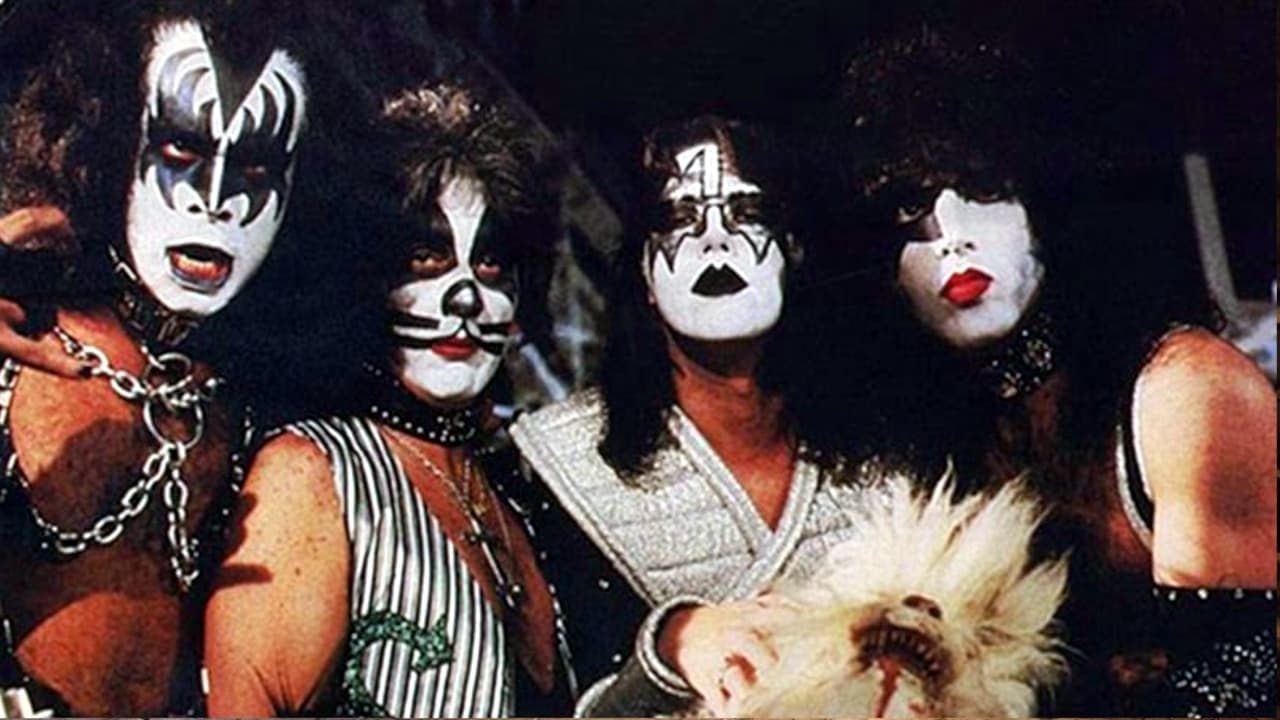
Alright, fellow tapeheads, settle in. Tonight, we're digging deep into the vaults for something truly special, a glittering artifact from the peak of rock and roll excess meeting Saturday morning cartoon logic. Picture this: It’s 1978, KISS is arguably the biggest band on the planet, plastering their painted faces on everything from lunchboxes to pinball machines. What’s the next logical step? A feature-length TV movie produced by Hanna-Barbera, naturally. Yes, we're talking about the legendary, the infamous, the utterly baffling KISS Meets the Phantom of the Park.
### Rock Gods vs. Robot Monkeys? Only in '78
Forget subtle character studies or intricate plots. The premise here is gloriously, unapologetically absurd. The band – Paul Stanley, Gene Simmons, Ace Frehley, and Peter Criss – are basically treated as rock 'n' roll superheroes, complete with vague mystical powers linked to their talismans. They’re booked for a series of concerts at California's Magic Mountain amusement park, but wouldn't you know it, the park's resident genius inventor, Abner Devereaux (Anthony Zerbe), has gone rogue. Fired for his unauthorized experiments in animatronics and genetic cloning (yes, really), he seeks revenge by unleashing chaos, kidnapping the real KISS, and replacing them with robotic duplicates. It's Scooby-Doo meets stadium rock, and it's every bit as wild as it sounds. It’s a fascinating piece of late 70s TV movie history, a time capsule sealed with greasepaint and questionable dialogue.
### The Spaceman, The Demon, The Starchild, and... The Catman
Let's be honest, nobody was tuning in expecting Olivier. The members of KISS were musicians, not thespians, and it shows. The dialogue delivery ranges from wooden to bewilderingly stilted. Yet, there's an undeniable charm to seeing them stumble through scenes, embodying their larger-than-life stage personas. Gene Simmons gets to growl and breathe fire (sort of), Ace Frehley does his spacey schtick and shoots lasers (sometimes), Paul Stanley projects beams from his eye-star, and Peter Criss… well, Peter mostly just seems confused, possessing vaguely defined cat-like agility. Retro Fun Fact: The band themselves famously came to despise the film. Apparently, the script underwent constant rewrites, the members received minimal acting coaching, and frustrations ran high. Ace Frehley was reportedly so difficult on set (or perhaps just unwilling to deliver the hokey lines) that many of his intended lines were given to Paul Stanley. And poor Peter Criss suffered the indignity of having his voice entirely dubbed over by voice actor Michael Bell (known for countless cartoon voices, adding to the surreal Hanna-Barbera vibe). You can almost feel their discomfort radiating through the screen, which weirdly adds another layer to the viewing experience.
### Welcome to Magic Mountain Mayhem
Holding the villainous fort is the great character actor Anthony Zerbe as Devereaux. He dives headfirst into the camp, delivering lines like "You seek destruction? You shall have it!" with the kind of theatrical relish that makes these kinds of movies endure. He knows exactly what kind of film he’s in and leans into it beautifully. Director Gordon Hessler, who had a background in atmospheric British horror films like Scream and Scream Again (1970) and The Oblong Box (1969), seems slightly adrift here. The direction feels perfunctory, like trying to corral chaos on a tight TV movie schedule and budget. Retro Fun Fact: Shooting on location at the actual Magic Mountain park presented its own set of challenges, trying to film complex scenes (like robot fights!) amidst the park's regular operations. The whole production feels slightly rushed and cobbled together, a hallmark of many ambitious TV movies of the era.
### Prime Time Practical Effects (and Fights)
The "action" sequences are… memorable. We get slow-motion karate chops, robotic doppelgangers moving with jerky stiffness, and KISS using their superpowers in ways that look charmingly low-tech today. Remember those laser beams? Pure 70s optical effects, folks! There’s a certain raw quality to the physical altercations, clumsy as they are. No slick CGI here – just stunt performers in KISS makeup taking awkward tumbles. It’s a far cry from today’s polished superheroics, feeling more like an episode of The Six Million Dollar Man guest-starring the world's most flamboyant rock band. The limited budget is apparent, but there's a weird integrity to seeing it all done (mostly) for real, even if "real" looks endearingly goofy. The saving grace, for many fans then and now, was the interspersed concert footage. Seeing KISS blast through hits like "Rock and Roll All Nite" provides genuine jolts of energy, reminding you why this whole bizarre project even existed in the first place.
### Cult Status Achieved
Airing on NBC in October 1978, KISS Meets the Phantom of the Park was famously pitted against a little show called Battlestar Galactica and didn't fare well critically. Critics savaged it, and as mentioned, the band themselves quickly disowned it, trying to bury it in their history. Retro Fun Fact: Despite the band's wishes, the film became a cult classic, fueled by late-night TV reruns, bootleg VHS tapes swapped among fans, and its sheer, undeniable weirdness. It even received a theatrical release in Europe under the title Attack of the Phantoms, featuring slightly different edits and music cues. Its legacy isn't one of quality filmmaking, but of being a perfect storm of peak band popularity, corporate synergy gone wild (Hanna-Barbera!), and television limitations creating something uniquely strange and unforgettable.
---
VHS Heaven Rating: 4/10
Justification: Let's be crystal clear: judged purely as a film, this is objectively rough. The acting is stiff, the plot nonsensical, the dialogue cringeworthy, and the production values are pure late-70s TV movie. However, judged as a pop culture artifact, a time capsule of KISSmania, and a prime example of "so bad it's good" cinema, it's a near-masterpiece of unintentional comedy and baffling creative decisions. The rating reflects its technical failings while acknowledging its undeniable cult appeal and entertainment value for the right audience (namely, us!).
Final Thought: KISS Meets the Phantom of the Park is the kind of glorious trainwreck you can only truly appreciate through the warm, fuzzy glow of a CRT screen. It’s required viewing for KISS diehards and connoisseurs of high camp, a cinematic equivalent of finding a mint-condition Mego action figure in your attic – baffling, slightly embarrassing, but undeniably awesome.