The Adventures of Sherlock Holmes and Dr. Watson: King of Blackmailers
It often feels like Sherlock Holmes belongs solely to the fog-drenched cobblestones of a London imagined by British studios. Yet, some of the most resonant and surprisingly faithful adaptations emerged from an entirely different world. Cast your mind back, perhaps not to a specific rental store find for many Western viewers, but to the discovery – maybe on a fuzzy late-night broadcast or a traded tape – of a Holmes and Watson speaking Russian, inhabiting a meticulously crafted Victorian England conjured behind the Iron Curtain. The Adventures of Sherlock Holmes and Dr. Watson, the Soviet television series that began in 1979, remains a revelation, and its 1980 installment, King of Blackmailers, is a potent example of its quiet brilliance.
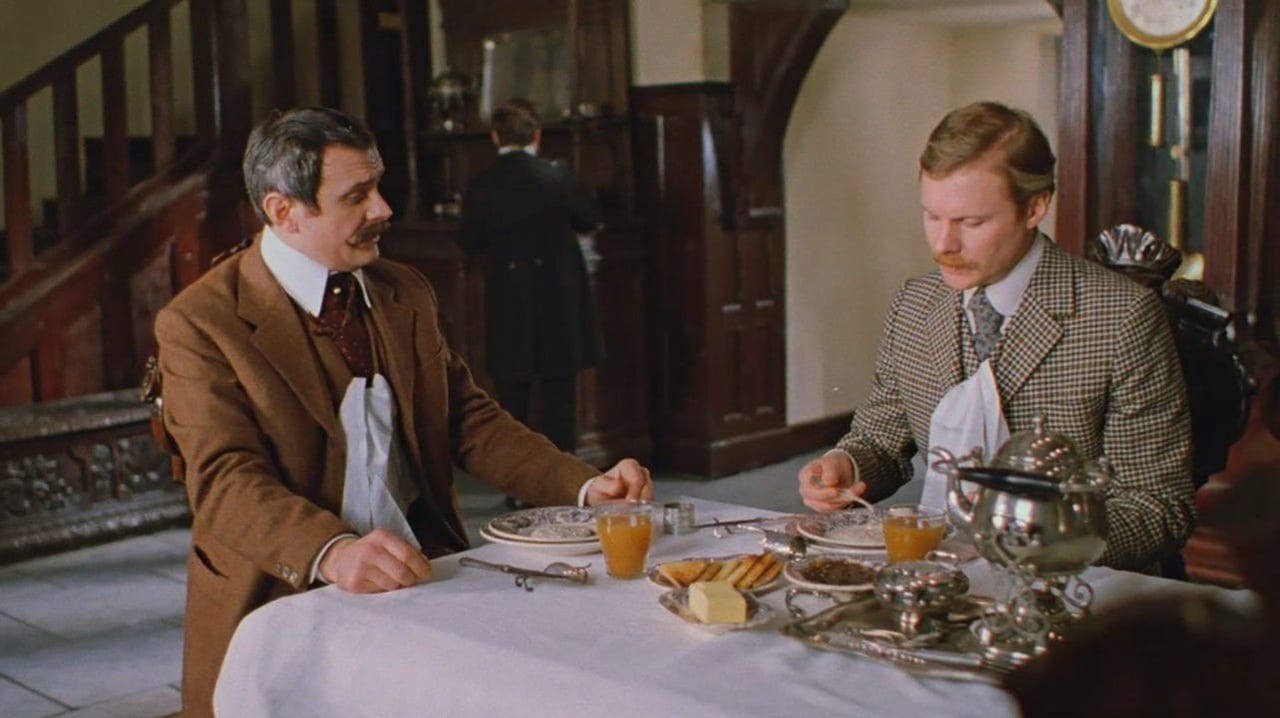
Beyond Baker Street, A Different Fidelity
Based on Sir Arthur Conan Doyle's chilling tale "The Adventure of Charles Augustus Milverton," King of Blackmailers plunges us into a morally murky case that tests Holmes's methods and ethics. Directed by Igor Maslennikov, who helmed the entire beloved series, this feature-length television film doesn't rely on frantic pacing or exaggerated eccentricities. Instead, it trusts the source material, allowing the inherent tension and psychological drama to unfold with a deliberate, almost literary grace. What immediately strikes you, watching it now, is the profound respect for Doyle's text, a faithfulness that many English-language adaptations, ironically, often sacrificed for spectacle. The dialogue feels drawn directly from the page, capturing the cadence and intellect of the original stories.
The Iconic Duo, Reimagined
At the heart of the series' enduring appeal are the performances of Vasiliy Livanov as Holmes and Vitaly Solomin as Watson. Livanov, with his aquiline features and piercing gaze, embodies the detective's fierce intellect. But it's his voice – a deep, unforgettable rasp – that truly defines his portrayal. Interestingly, this signature sound wasn't an affectation; Livanov reportedly lost his voice permanently during a challenging outdoor winter shoot for another film years earlier, inadvertently creating one of the most distinctive Holmes voices in screen history. It lends his pronouncements an undeniable gravity. He captures Holmes's intensity, his flashes of dry wit, and, crucially, his underlying sense of justice, however unconventional his methods. So iconic was his performance that Vasiliy Livanov was later awarded an honorary MBE (Member of the Order of the British Empire) by Queen Elizabeth II herself – a remarkable acknowledgment bridging cultural divides.
Complementing him perfectly is Vitaly Solomin's Watson. Far from the bumbling sidekick often depicted, Solomin presents Watson as intelligent, observant, and deeply loyal – the true chronicler and friend. There's a warmth and groundedness to his portrayal that makes their partnership feel genuine and lived-in. Their quiet moments together in the Baker Street flat, often enriched by the presence of the delightfully pragmatic Mrs. Hudson (Rina Zelyonaya, a legendary figure in Soviet cinema), feel utterly authentic. The chemistry between Livanov and Solomin is the bedrock upon which the entire series stands.
Weaving a Tangled Web
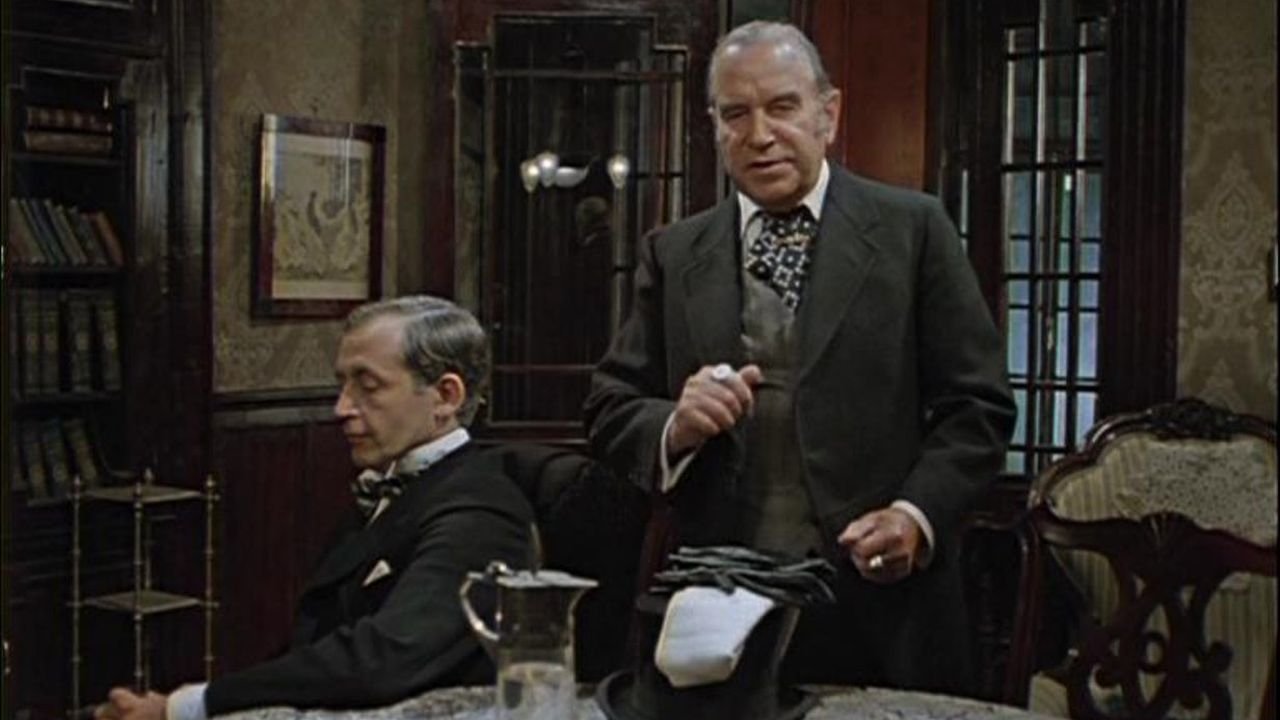
King of Blackmailers introduces one of Doyle's most repellent villains: Charles Augustus Milverton, played with icy precision by Boris Klyuyev. Milverton isn't a mastermind of complex crimes, but a "king" of social destruction, profiting from secrets and ruined lives. Klyuyev embodies the character's reptilian charm and utter lack of empathy, making him a truly loathsome figure. The film doesn't shy away from the ugliness of his trade or the desperation of his victims. This is where the episode’s reflective quality truly shines. We’re forced to confront the limits of the law when faced with such insidious evil. Can Holmes operate outside its bounds to achieve a just outcome?
Crafting Victorian London in the Baltics
One of the most fascinating aspects of the series is its visual creation of Victorian London. Lacking access to the actual locations, Maslennikov and his team resourcefully used the streets and architecture of Riga, Latvia (along with Leningrad/St. Petersburg and Tallinn, Estonia across the series) to stand in for Baker Street and its environs. The result is surprisingly effective, capturing a tangible sense of period atmosphere through careful set dressing, costuming, and cinematography. While perhaps lacking the grimy authenticity of some British productions, there’s a distinct, slightly formal beauty to this Soviet London, enhanced by Vladimir Dashkevich's memorable, evocative musical score that became instantly recognizable across the Soviet Union. The production values, particularly for Soviet television of the era, were notably high, reflecting the prestige of the project. Even Inspector Lestrade, portrayed by Borislav Brondukov, feels right, fitting seamlessly into this carefully constructed world.
Moral Shadows and Lasting Impressions
Spoiler Alert! The climax of "The Adventure of Charles Augustus Milverton" involves Holmes and Watson witnessing Milverton's murder at the hands of a former victim and allowing her to escape. The Soviet adaptation handles this difficult sequence with a steady, non-judgmental gaze. It presents Holmes's decision not as heroic defiance, but as a pragmatic, perhaps even reluctant, acceptance of a form of justice the legal system couldn't provide. It leaves the viewer pondering the complexities – is inaction in the face of 'justifiable' murder complicity? Where does the detective's duty end and personal morality begin? These aren't easy questions, and the film respects the audience enough to let them linger.
This wasn't just another detective show; for millions in the Soviet Union and Eastern Bloc, this was Sherlock Holmes. Its popularity was immense, embedding Livanov and Solomin in the cultural consciousness. Finding these tapes now, or streaming them, feels like uncovering a hidden chapter in Holmesian history – one crafted with intelligence, care, and a surprising degree of soul.
Rating: 8/10
This score reflects the exceptional lead performances, the remarkable faithfulness to Doyle's spirit and text, and the evocative atmosphere created under unique production circumstances. While perhaps lacking the budget and grit of some Western counterparts, its thoughtful approach and iconic portrayals make it essential viewing. It might not be the Holmes you grew up renting weekly, but discovering King of Blackmailers feels like finding a rare gem – a testament to the universal appeal of Conan Doyle's creation and the talent that brought it to life so vividly, thousands of miles from Baker Street. What lingers most is the quiet confidence of its storytelling, proving that a great detective story transcends borders and languages.