There's a particular kind of quiet unease that settles when the expected patterns of life are suddenly disrupted. It’s that feeling that hangs heavy in the air at the start of Carlo Verdone's 1992 film, Al lupo, al lupo (often translated as Wolf! Wolf!). What begins as a simple, perhaps even darkly comic, premise – three estranged adult siblings searching for their mysteriously vanished artist father – quickly unfolds into something more complex, a bittersweet journey through landscapes both geographical and emotional. This wasn't a tape likely found crowding the 'New Releases' wall at Blockbuster back in the day, at least not stateside, making it precisely the kind of thoughtful Euro-gem VHS Heaven cherishes.
A Reluctant Reunion on Tuscan Roads
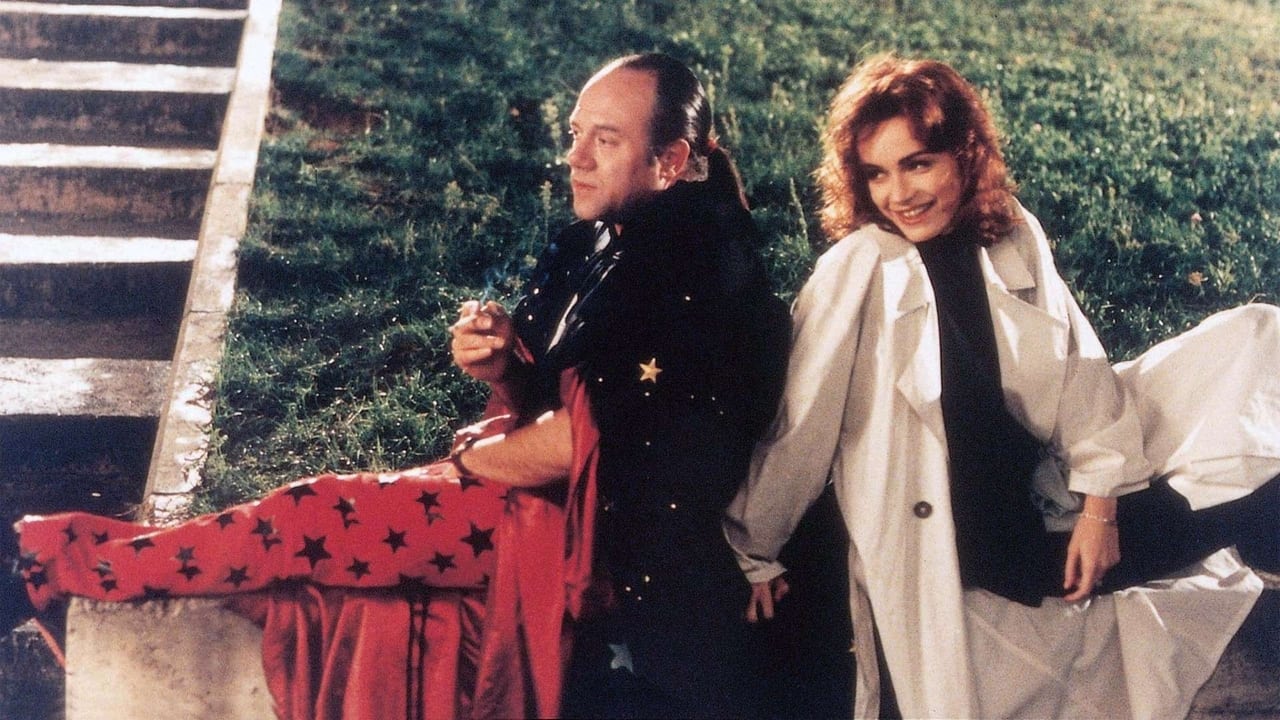
The setup is instantly relatable, despite its Italian specificity. Gregorio (Carlo Verdone), a somewhat insecure musician; Livia (Francesca Neri), outwardly successful but emotionally guarded; and Vanni (Sergio Rubini), the eccentric, free-spirited youngest, are forced back into each other's orbits when their larger-than-life father disappears from his Tuscan villa. What follows is less a detective story and more a road movie of reluctant reconciliation. Their search meanders through picturesque Italian towns and countryside, beautifully captured, serving as a scenic backdrop to the messy, often funny, and deeply felt unpacking of decades of shared history and individual grievances. Verdone, directing himself, uses the journey structure effectively, letting the physical travel mirror the internal shifts within the siblings. Remember those family road trips where proximity bred both irritation and unexpected closeness? Al lupo, al lupo taps into that same dynamic, albeit with considerably higher emotional stakes.
A Trio of Truthful Performances
The heart of the film lies squarely with its three leads. Carlo Verdone, a comedic giant in Italy often compared to figures like Billy Crystal for his relatable neuroses, dials back some of his broader comedic instincts here. His Gregorio is anxious and often serves as the exasperated mediator, embodying the weight of responsibility many eldest siblings feel. It's a performance grounded in familiar anxieties. Opposite him, Francesca Neri, who international audiences might recognize from later roles like Allegra Pazzi in Hannibal (2001), brings a captivating mix of strength and vulnerability to Livia. She’s the one who seemingly escaped the family orbit, yet her carefully constructed independence feels fragile, hinting at deeper wounds.
But it’s Sergio Rubini as Vanni who often steals the show, deservedly winning a David di Donatello (Italy’s Oscar equivalent) for Best Supporting Actor. Vanni is the oddball, the DJ seemingly adrift, yet he often possesses the most surprising moments of insight and emotional honesty. His interactions with Verdone and Neri crackle with the authentic push-and-pull of sibling relationships – the shared jokes, the sudden flare-ups, the unspoken understandings. Their chemistry feels lived-in, making their gradual reconnection believable and touching. It’s in their bickering, their shared moments of absurdity, and their eventual tentative embraces that the film finds its most resonant truths.
Verdone's Gentle Touch
As a director, Carlo Verdone (who also co-wrote the screenplay with Francesca Marciano and Pasquale Plastino) demonstrates a deft hand in balancing the comedic and the dramatic. The film never tips too far into farce or melodrama. The humour arises naturally from the characters and their situation, often tinged with a melancholic awareness of time lost and opportunities missed. Verdone has always excelled at observing the nuances of Italian life and relationships, and Al lupo, al lupo continues that tradition, exploring themes of parental influence, the difficulty of escaping family patterns, and the bittersweet nature of confronting the past. It's worth noting the beautiful, evocative score by Manuel De Sica (son of the neorealist master Vittorio De Sica), which also picked up a David di Donatello. It subtly underscores the emotional currents without ever becoming intrusive, perfectly complementing the Tuscan landscapes and the characters' inner turmoil.
Finding More Than a Father
Interestingly, the title Al lupo, al lupo references the fable "The Boy Who Cried Wolf." Does it suggest the father's disappearance is just another dramatic gesture, a false alarm in a life full of them? Or does it hint at a real, perhaps emotional, danger the siblings must ultimately confront? The film leaves this interpretation open, focusing less on the mystery of the father's whereabouts and more on what the siblings rediscover about themselves and each other during the search. This wasn't a massive international hit, but it performed well in Italy, further cementing Verdone's status as a filmmaker deeply attuned to the pulse of his country. Watching it now, perhaps on a worn-out VHS copy dug out from a collector's stash, feels like uncovering a personal, poignant story that uses its specific Italian setting to explore universal anxieties about family and belonging.
The search itself becomes secondary to the rediscovery of fraternal bonds, however frayed. What does it mean to reconnect with the people who knew you first, before the world shaped you into who you are today? Can you ever truly escape the gravitational pull of family, for better or worse? These are the questions that linger long after the credits roll.
Rating: 8/10
This score reflects the film's strong, authentic performances, particularly from the central trio, Carlo Verdone's sensitive direction that masterfully balances humour and pathos, and its thoughtful exploration of complex family dynamics. The pacing is unhurried, demanding a certain patience, and its specific Italian cultural context might make some nuances less immediate for international viewers, but the emotional core is universal and deeply affecting. It’s a film that rewards viewers seeking character-driven storytelling over plot pyrotechnics.
Al lupo, al lupo is a reminder that sometimes the journeys forced upon us, even those born from worry and uncertainty, lead us back to the connections that truly matter. It's a warm, melancholic embrace of a film, perfect for a reflective evening.