The oppressive humidity of 1960s Beijing seems to cling to the screen long after the opening scenes of David Cronenberg's M. Butterfly have passed. It’s more than just weather; it’s the atmosphere of secrets, of unspoken desires and profound misunderstandings that permeates this haunting 1993 drama. This wasn't the typical fare lighting up the New Releases wall at Blockbuster, nestled perhaps uneasily between the action blockbusters and lighter comedies. Seeing Cronenberg's name, often associated with the visceral body horror of The Fly (1986) or Videodrome (1983), attached to what appeared to be a period romance/spy thriller was intriguing in itself. It promised something… different. And different it certainly was.
### A Stage Set for Deception
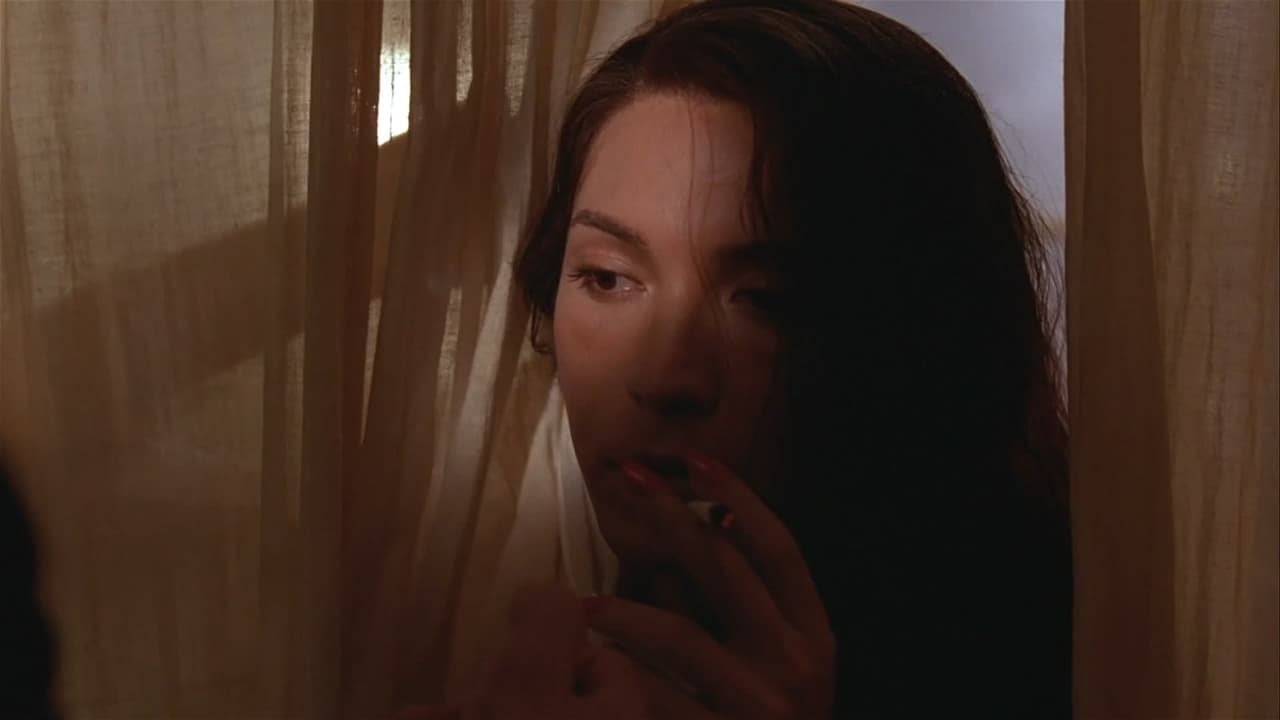
Based on the Tony Award-winning play by David Henry Hwang (who also adapted the screenplay), M. Butterfly recounts the improbable, almost unbelievable relationship between René Gallimard (Jeremy Irons), a mid-level French diplomat, and Song Liling (John Lone), a captivating star of the Peking Opera. Gallimard, mild-mannered and trapped in a passionless marriage (Barbara Sukowa offers quiet strength as his wife, Jeanne), becomes utterly mesmerized by Song's portrayal of Cio-Cio-San in Puccini's Madama Butterfly. He sees in Song the embodiment of his fantasies: the submissive, devoted Oriental woman willing to sacrifice everything for her Western man. Their affair blossoms over years, a dangerous liaison intertwined with Gallimard's unwitting involvement in espionage, feeding information through his seemingly delicate lover.
The film masterfully builds this central relationship, layering Gallimard’s romantic projection upon Song’s enigmatic performance, both on and off the stage. Irons, fresh off his Oscar win for Reversal of Fortune (1990), is perfectly cast as Gallimard. He brings a palpable sense of repressed longing, intellectual vanity, and ultimately, tragic self-delusion to the role. You see the subtle shifts in his posture, the flicker of obsession in his eyes as he convinces himself of the fantasy he has constructed. It’s a performance built on nuance, capturing a man simultaneously arrogant and deeply insecure. Interestingly, William Hurt was initially set to play Gallimard but dropped out, paving the way for Irons – a change that arguably brought a different, perhaps more brittle, vulnerability to the character.

### The Unveiling of Illusion
Of course, the film hinges on a staggering central conceit, one rooted in an equally staggering true story – that of French diplomat Bernard Boursicot and Peking opera singer Shi Pei Pu. Spoiler Alert! Gallimard's decades-long affair is built on the belief that Song Liling is a woman, unaware that female roles in Peking Opera were traditionally played by men. The film navigates this reveal carefully, focusing less on the mechanics of the deception and more on the profound psychological implications. What does it mean for Gallimard’s identity, his masculinity, his entire worldview, when the "perfect woman" he worshipped is revealed to be a man, and a spy manipulating his Orientalist fantasies against him?
John Lone's performance as Song Liling is nothing short of extraordinary. It's a tightrope walk of ambiguity and control. He portrays both the delicate, captivating opera singer and the shrewd, calculating individual beneath the robes and makeup. There's a quiet power in his stillness, a depth in his gaze that suggests layers of hidden knowledge and perhaps even conflicted feelings. The chemistry between Irons and Lone is complex and charged, built not on conventional romance but on a potent mix of obsession, performance, and intellectual sparring. Cronenberg, known for exploring transformations of the flesh, here delves into transformations of identity and perception, making it a fascinating, if less graphic, entry in his filmography. He was reportedly drawn precisely to these themes of illusion and metamorphosis, seeing a parallel to his previous work.

### Cronenberg's Restrained Gaze
While lacking the overt viscera of his earlier films, Cronenberg's signature clinical, almost detached style is very much present. He observes Gallimard’s downfall with an unsettling calm, allowing the emotional weight to accumulate through performance and atmosphere rather than overt directorial flourishes. The pacing is deliberate, sometimes bordering on slow, demanding patience from the viewer. Filming took place across Beijing, Budapest, and Paris, adding an authentic sense of place, though navigating filming in China presented its own set of production challenges in the early 90s. The film’s visual language emphasizes confinement – the cramped diplomatic circles, the shadowy intimacy of Song’s apartment, and ultimately, the stark reality of a prison cell. Howard Shore's score subtly blends Western operatic themes with Eastern influences, underscoring the cultural collision at the heart of the story.
Despite the pedigree of its source material, director, and stars, M. Butterfly wasn't a commercial success, grossing only around $1.5 million domestically. Perhaps its challenging themes, ambiguous characters, and measured pace were a difficult sell for mainstream audiences at the time. Critical reception was also mixed, with some finding it emotionally distant compared to the acclaimed stage play. Yet, watching it now, perhaps on a worn VHS tape pulled from the back of the collection, its power feels undiminished. It asks uncomfortable questions about the nature of love, the danger of stereotypes, and the elaborate lies we tell ourselves.
### Lasting Impressions
M. Butterfly is not an easy film, nor is it a conventionally satisfying one. It leaves you with a sense of profound melancholy and a swirl of complex questions rather than neat answers. It's a film that rewards contemplation, a character study wrapped in espionage and illusion. The performances, particularly from Irons and Lone, are hypnotic, drawing you into a world where fantasy and reality blur disastrously.
Rating: 7.5/10
The score reflects a film of considerable intelligence and artistry, anchored by superb lead performances and Cronenberg's unique directorial vision applied to unexpected material. It might lack the immediate visceral punch of his horror work or the emotional accessibility of the stage play for some, keeping it from higher marks, but its thematic depth and psychological insight are undeniable. It’s a challenging, haunting piece that lingers, much like the scent of jasmine and the echo of an aria in a humid Beijing night. A stark reminder that sometimes the most devastating illusions are the ones we create for ourselves.