There's a certain weight that settles on a film when it carries the hopes – or perhaps the perceived hubris – of a star stepping away from television phenomenon into the unforgiving glare of the big screen. That was the shadow looming over 1995's Kiss of Death, the vehicle chosen by David Caruso after his much-publicized, slightly acrimonious departure from the grit and glory of NYPD Blue. I remember the buzz distinctly; renting this felt less like picking up just another crime thriller and more like witnessing a high-stakes gamble unfold right there on the magnetic tape. Would Caruso become the next big movie star? The film itself, a remake of the 1947 noir classic, arrived with pedigree – directed by the astute Barbet Schroeder (Reversal of Fortune, Single White Female) and penned by the master of urban decay dialogue, Richard Price (Clockers, The Wire). Yet, watching it again now, decades removed from the initial hype, reveals a film wrestling with its own identity, anchored by a central performance straining under pressure, and ultimately hijacked by one of the most volcanically memorable supporting turns of the 90s.
Shadows of Loyalty and Betrayal
At its core, Kiss of Death is a familiar story, steeped in the fatalistic ink of noir. Caruso plays Jimmy Kilmartin, a reformed car thief trying to go straight in Queens, pulled back into "one last job" for his volatile cousin Ronnie (a reliably twitchy Michael Rapaport). Naturally, things go sideways, landing Jimmy in Sing Sing. Pressured by ADA Frank Zioli (Stanley Tucci, sharp as ever) and haunted by the image of his wife Bev (Helen Hunt, bringing quiet strength) struggling on the outside, Jimmy makes a deal. He informs on the crew, hoping for a ticket back to normalcy. But normalcy is a fragile concept when your path crosses with Little Junior Brown, a charismatic, asthmatic, utterly terrifying gangster played with supernova intensity by Nicolas Cage. The plot then follows Jimmy's perilous tightrope walk: trying to maintain his cover, protect his family (including a new love interest played by Kathryn Erbe after tragedy strikes), and navigate the increasingly dangerous demands of both law enforcement, represented by the weary Detective Calvin Hart (Samuel L. Jackson, radiating stoic authority), and the explosive unpredictability of Little Junior.
Caruso's Calculated Cool

Caruso's performance as Jimmy Kilmartin is central, obviously, and it’s… complicated. He brings a certain world-weariness, a coiled tension befitting a man constantly looking over his shoulder. His trademark stillness, the slight head tilt, the quiet intensity – it's all there. But where Detective John Kelly crackled with raw, reactive energy on the small screen, Jimmy Kilmartin often feels muted, almost hesitant. Was this a deliberate choice, reflecting Jimmy's desperate attempt to remain invisible, or was it the actor struggling to fill the larger canvas of cinema? It's hard to say definitively. There are moments where his quiet desperation lands, where you feel the impossible bind he's in. Yet, there's also a sense that the simmering charisma which made him a TV icon doesn't fully ignite here. The gamble, unfortunately, didn't quite pay off in terms of launching a major movie career, a fact underlined by the film's disappointing box office ($14.9 million domestic against a reported $40 million budget).
The Unforgettable Force of Nature
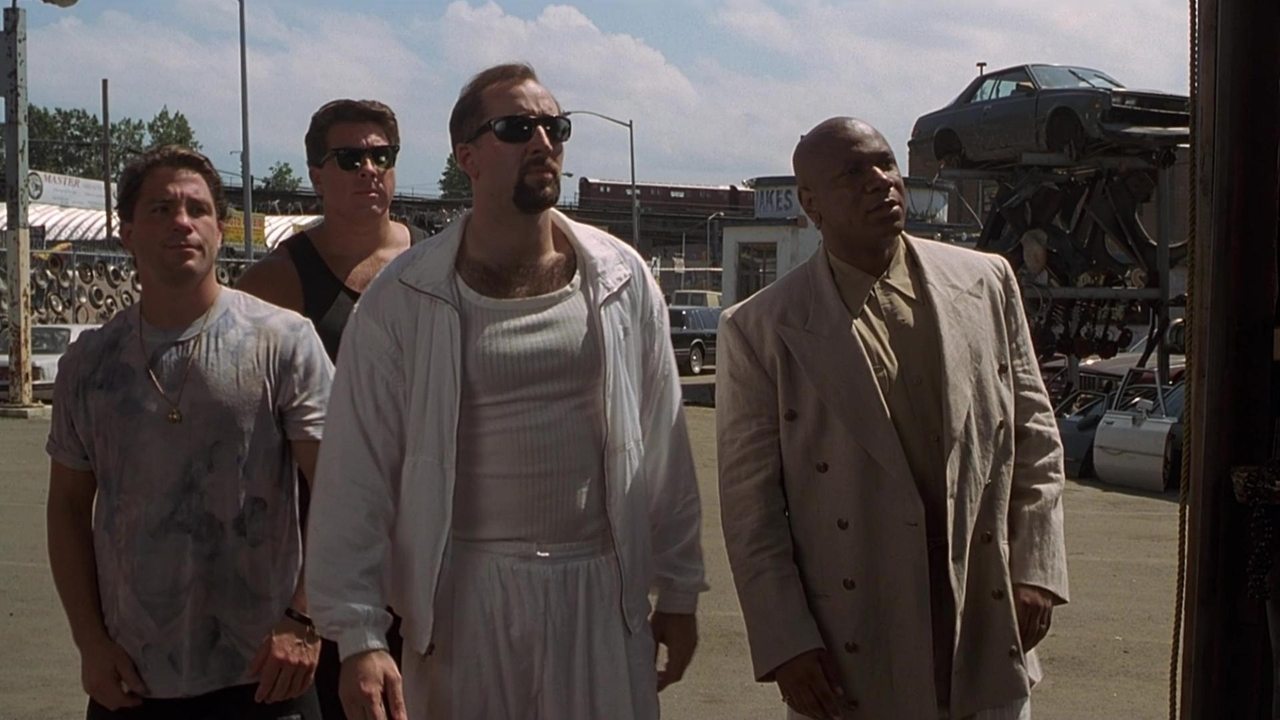
And then there's Little Junior. Oh, Little Junior. Nicolas Cage doesn't just enter the film; he detonates within it. This isn't merely scene-stealing; it's grand larceny on a cinematic scale. Reportedly gaining significant muscle mass for the role, Cage crafts a villain simultaneously terrifying and bizarrely compelling. His Little Junior is a creature of raw impulse: bench-pressing a stripper, delivering chilling threats between puffs on an asthma inhaler, radiating a manic energy that borders on the operatic. It’s a performance of pure, unadulterated Cage-ness, a whirlwind of physical ticks, unpredictable line readings, and terrifying vulnerability. It's easy to see echoes of Richard Widmark's giggling psychopath Tommy Udo from the original 1947 Kiss of Death, but Cage makes Little Junior entirely his own unforgettable creation. It’s a performance so potent, so wildly entertaining, that it throws the entire film slightly off-balance. You find yourself waiting, almost impatiently, for his next appearance. Little Junior wasn't just a character; he was an event.


Gritty Craftsmanship
Beyond the performances, Barbet Schroeder directs with a sure hand, capturing the grimy textures of Queens and the oppressive atmosphere of the criminal underworld. Luciano Tovoli's cinematography often bathes scenes in harsh, realistic light, avoiding romanticism. Richard Price's script crackles with authentic street-level dialogue, even if the plot mechanics feel somewhat well-trodden within the genre. The film looks and sounds like a solid 90s crime thriller, grounded and tense. There’s a palpable sense of place and a pervasive feeling of dread that Schroeder sustains effectively throughout. The supporting cast, including Ving Rhames in a small but memorable role as Junior's taciturn associate Omar, adds considerable weight.
Legacy on the Shelf
Watching Kiss of Death today is an interesting experience. The Caruso narrative looms large, a 'what might have been' moment frozen on VHS. But divorced from that specific context, it stands as a well-crafted, often gripping neo-noir thriller. It explores familiar themes – the impossibility of escaping one's past, the corrosive nature of betrayal, the desperate search for redemption in a fallen world – with intelligence and grit. Does Jimmy’s ultimate choice truly offer freedom, or just another kind of cage? The film leaves you pondering the messy compromises required for survival.

Rating: 7/10
The rating reflects a solid, atmospheric crime drama elevated significantly by its supporting cast, particularly Nicolas Cage's iconic, unrestrained performance. While David Caruso delivers a serviceable lead turn, he feels somewhat overshadowed, unable to fully escape the expectations set by his television success or compete with Cage's sheer force-of-nature presence. Richard Price's script and Barbet Schroeder's direction provide a strong foundation, creating a tangible sense of place and tension. However, the film doesn't quite transcend its genre trappings or the shadow of its central casting story.
Ultimately, Kiss of Death might be remembered less as the star vehicle it was intended to be, and more as a prime example of 90s Cage unbound, a gritty thriller that delivers suspense even as it serves as a fascinating snapshot of Hollywood ambition and consequence. It's a tape worth revisiting, perhaps not for the story you expected going in, but for the electrifying one that unfolds whenever Little Junior Brown steps into the frame.