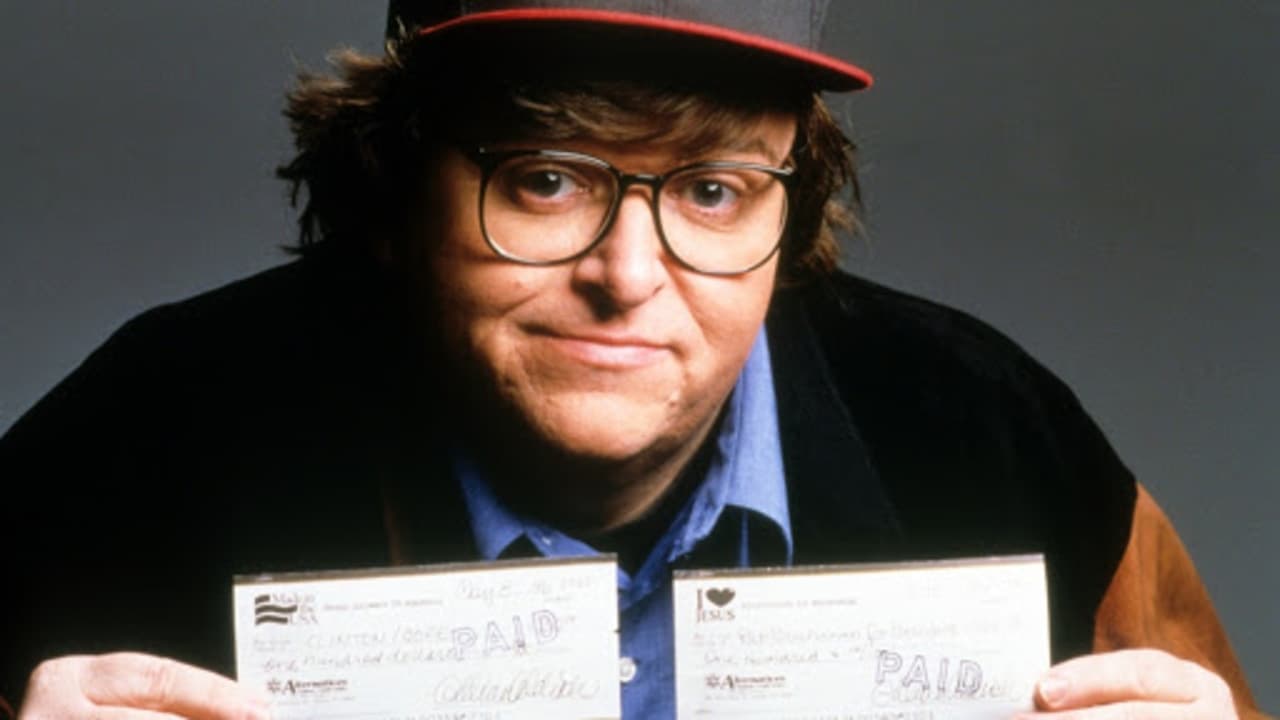
It starts, as so many things did in the late 90s, with a book tour. But this wasn't just any author hitting the road; this was Michael Moore, fresh off the success of "Downsize This!", turning what should have been standard bookstore Q&As and signings into a travelling circus of corporate confrontation. Watching The Big One (1997) again, possibly dug out from a dusty box of tapes like I did, feels less like revisiting a simple documentary and more like unearthing a time capsule of anxieties that still resonate sharply today. There he is, the familiar figure in the baseball cap, microphone extended like a hopeful olive branch (or perhaps a gentle prod), trying to get CEOs to answer for mass layoffs.
Hitting the Road (and Corporate Walls)
The premise is ingenious in its simplicity: use the publisher's dime for the book tour across America's struggling heartland to simultaneously film a follow-up to his groundbreaking Roger & Me (1989). It’s a structure born of Moore's particular brand of scrappy resourcefulness. He isn't just signing books; he's visiting companies notorious for downsizing – Payday loan centers offering predatory rates, factories moving jobs overseas – and attempting, often futilely but always pointedly, to engage the executives at the top. There's a raw, almost C-SPAN-after-hours feel to some of these encounters, the static hum of fluorescent lights in empty lobbies serving as the backdrop to polite stonewalling.
Moore himself is the central performance, of course. It’s the persona already becoming iconic: the slightly bumbling, ostensibly naive everyman who just wants to ask a few simple questions. Yet beneath the schlubby exterior is a sharp, persistent interrogator, armed with research and a refusal to be easily dismissed. Does his approach sometimes feel like a stunt? Absolutely. But does it effectively highlight the absurdity and often callous nature of corporate speak and the human cost of profit maximization? Undeniably. He embodies the frustration of the average person wanting accountability from faceless institutions. I remember seeing this back in the day, perhaps rented from Blockbuster alongside some forgettable action flick, and being struck by how different it felt – part comedy routine, part investigative journalism, part cri de cœur.
Nike and the Knight
The most memorable sequence, and the one that generated the most buzz at the time, involves Moore’s pursuit of Nike and its then-CEO, Phil Knight. Moore cleverly uses the book tour stop in Portland, Oregon, to visit Nike headquarters. He highlights the stark contrast between Nike's massive profits and image-conscious marketing ("Just Do It") and the documented use of cheap overseas labour, particularly child labour in countries like Indonesia. Moore’s attempt to present Knight with a plane ticket to Indonesia to see the factories firsthand is classic Moore: a provocative gesture designed for maximum impact.
What makes the Nike segment compelling is that Knight actually engages. It’s awkward, tense, and revealing. Knight, visibly uncomfortable but trying to maintain corporate composure, defends Nike's practices while making startling admissions, like suggesting Americans wouldn't want those low-wage manufacturing jobs anyway. It’s a rare glimpse behind the curtain, facilitated entirely by Moore's relentless, almost cheerful persistence. It wasn't just a quick ambush; according to reports, Nike knew Moore was coming as part of the book tour publicity, which perhaps explains Knight's willingness (or perceived obligation) to meet him, however briefly. This interaction alone justifies the film's existence, capturing a specific moment in the burgeoning anti-globalization discourse.
Echoes of Downsizing
Beyond the big Nike confrontation, the film finds power in its smaller moments: the conversations with laid-off workers, the visit to the factory making novelty Reads Raisinets (a moment of surreal levity), the encounter with Garrison Keillor offering his dry Midwestern wisdom. It paints a picture of an America grappling with economic shifts, where loyalty feels like a one-way street and the gap between the boardroom and the factory floor seems impossibly vast. Wasn't this the gnawing feeling many of us had back then, watching industries change and jobs disappear, wondering where it was all heading?
The Big One isn't as tightly focused as Roger & Me, feeling more episodic due to its book tour structure. Some encounters fizzle out, and Moore's shtick can occasionally wear thin depending on your tolerance for it. Yet, its sprawling nature also feels appropriate for the subject – the problem wasn't confined to one town like Flint; it was everywhere. The film earned a modest $730,000 at the box office, a respectable sum for a documentary built around such an unconventional premise, further solidifying Moore's place as a unique voice in American filmmaking. It’s a snapshot of late-90s discontent, filtered through Moore’s unique lens – funny, infuriating, and surprisingly prescient.
Rating: 7/10
The Big One earns a solid 7. While perhaps less groundbreaking than Roger & Me and occasionally rambling, its central conceit is brilliant, the Nike confrontation is documentary gold, and Moore's ability to blend humor with sharp social critique remains potent. It effectively captures the anxieties of its era regarding corporate power and globalization, themes that haven't exactly faded away. The film showcases Moore honing the confrontational style that would define his later, more controversial works.
It might not be the first Michael Moore film people reach for, but watching The Big One on that slightly fuzzy VHS tape feels like finding a vital piece of the puzzle, a bridge between his initial splash and his later status as a polarizing global figure. It leaves you pondering not just the specific issues of 1997, but the enduring question: who gets to ask the powerful the uncomfortable questions, and will they ever truly listen?