There's a particular kind of unease that settles in the pit of your stomach when innocence brushes up against something dangerous it doesn't quite comprehend. It’s a feeling masterfully captured in Shane Meadows' 1999 film, A Room for Romeo Brass, a work that lingers long after the credits, leaving you contemplating the fragile boundary between childhood camaraderie and the unsettling realities of the adult world. This isn't your typical glossy coming-of-age tale; it’s raw, grounded, and carries a current of genuine threat beneath its seemingly ordinary surface.
Midlands Sun and Gathering Clouds
We're introduced to 12-year-olds Romeo Brass (Andrew Shim) and Gavin 'Knocks' Woolley (Ben Marshall) kicking around their suburban neighbourhood in the English Midlands. Their friendship feels utterly authentic – the easy banter, the shared anxieties (Knocks suffers from a back condition), the slightly aimless rhythm of pre-teen life. Meadows, co-writing with his long-time collaborator Paul Fraser (drawing loosely on Fraser's own childhood experiences), has an incredible ear for the way kids actually talk and interact. There's a warmth and gentle humour in these early scenes, establishing a world you feel you could step right into, perhaps triggering memories of similar youthful bonds from our own pasts. I recall seeing this not on VHS, but on a slightly battered DVD rented somewhat randomly, unaware of the emotional journey I was about to undertake. The initial charm felt familiar, comforting even.
Enter Morell: The Unsettling Neighbour
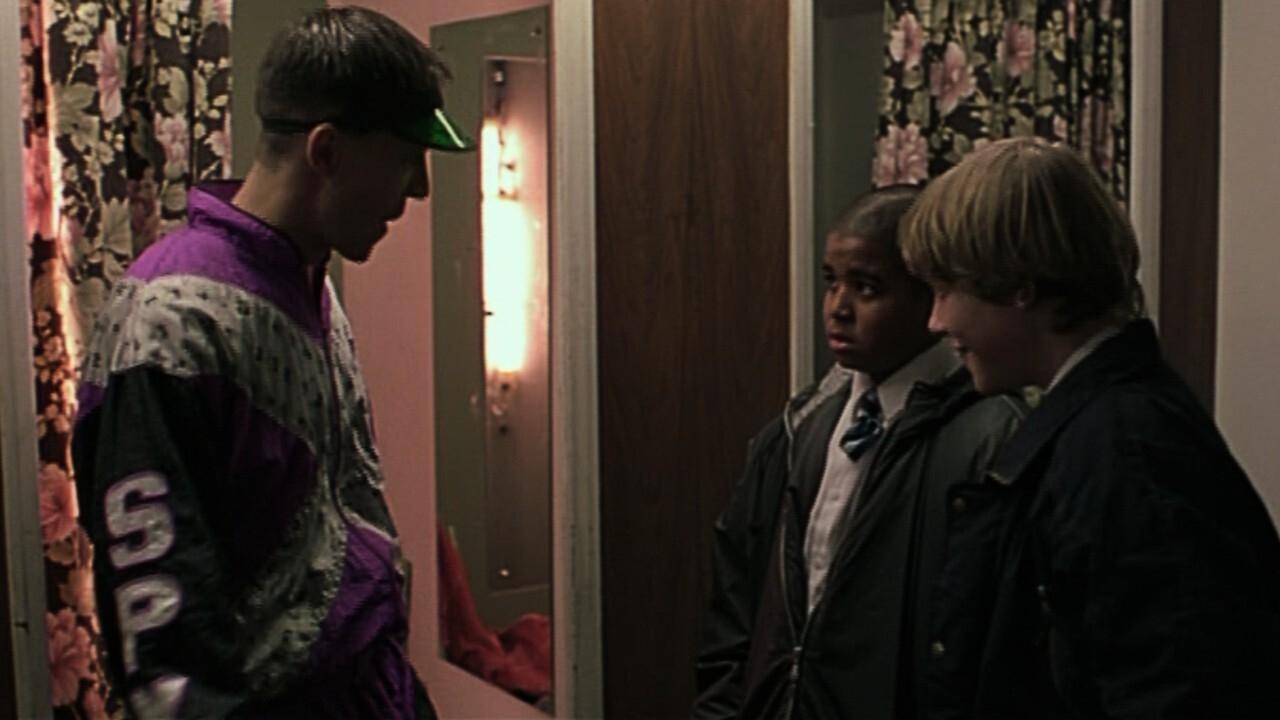
The dynamic shifts irrevocably with the arrival of Morell, played in a truly startling feature film debut by Paddy Considine. Morell is older, eccentric, oddly charismatic, and lonely. He rescues the boys from a confrontation and quickly insinuates himself into their lives, particularly latching onto Romeo, whom he seems to view with a strange, possessive fascination. What begins as awkward friendship curdles gradually into something deeply unnerving. Considine's performance is nothing short of electrifying. He portrays Morell not as a cartoon villain, but as a deeply troubled, unpredictable man whose attempts at connection are warped by obsession and a barely concealed potential for menace. His physical presence is awkward, his emotional shifts sudden and jarring – one moment offering seemingly naive pronouncements, the next radiating quiet intensity.
It's fascinating trivia that Considine wasn't a trained actor at the time; Meadows knew him from college and persuaded him to take the role. This lack of formal training, combined with Meadows' encouragement of improvisation around the script, arguably contributes to the terrifying authenticity of the performance. There's no polish, no actorly tricks – just the raw, unsettling presence of Morell, a character who feels disturbingly real precisely because he lacks the manufactured smoothness of conventional movie antagonists.
The Slow Tightening of the Screw
Shane Meadows, who had already shown his talent for gritty realism with Twenty Four Seven (1997), directs with a patient, observational style. He lets the tension build organically, often through subtle shifts in Morell’s behaviour or the dawning awareness in Romeo’s eyes. The low budget (reportedly around £700,000) and shooting on location in Nottinghamshire lend the film an unvarnished, documentary-like feel, perfectly suited to the material. There are no flashy cinematic tricks here; the power comes from the performances and the slow, almost unbearable tightening of the narrative screw as Morell’s fixation on Romeo’s older sister (Vicky McClure, another future Meadows regular in an early role) becomes apparent.
The film forces us to confront uncomfortable questions. How does manipulation begin? How easily can vulnerability be exploited? Morell’s actions become increasingly disturbing, yet the boys, initially flattered by the attention of an older figure, struggle to process the danger they are in. Doesn't this gradual encroachment resonate with how threats often manifest in real life – not with a sudden bang, but a slow, insidious creep?
A Defining Debut and Lasting Unease
While Shim and Marshall are wonderfully naturalistic as the young leads, embodying the confusion and loyalty of youth under pressure, it is Considine's Morell that burns itself into memory. It's a performance that rightly launched a major acting career (leading to powerful roles in films like Dead Man's Shoes and Tyrannosaur, the latter of which he also directed). A Room for Romeo Brass might not have been a massive box office smash, but its critical acclaim was significant, cementing Meadows' reputation as a vital voice in British cinema – a path that would eventually lead to the landmark This Is England series.
The film captures that specific late-90s moment, just before the turn of the millennium, but its themes are timeless. It’s a stark reminder that the world can be a dangerous place, and that the lines between friendship, loneliness, and predation can sometimes blur with terrifying ease. It avoids easy answers or neat resolutions, leaving the viewer with a lingering sense of disquiet.
Rating: 9/10
This rating reflects the film's exceptional, authentic performances, particularly Paddy Considine's unforgettable debut, Shane Meadows' assured and grounded direction, and its powerful, unsettling exploration of innocence confronted by menace. The naturalism is pitch-perfect, drawing you into the boys' world before subtly revealing the darkness encroaching upon it. While its deliberate pace and grim undertones might not be for everyone, its impact is undeniable. It doesn't just tell a story; it evokes a feeling – that knot in the stomach when something is fundamentally wrong, even if you can't immediately name it.
A Room for Romeo Brass is a potent piece of late 90s British filmmaking, a coming-of-age story laced with genuine peril that showcases emerging talents firing on all cylinders. It’s the kind of film that gets under your skin, a quiet disturbance you won't easily shake off.