There’s a certain ache that comes with looking back, isn’t there? Not just the sweet pang of nostalgia, but the more complex thrum of understanding how profoundly time reshapes us, sanding down the sharp edges of youthful certainty, leaving behind a landscape both familiar and irrevocably altered. It’s this precise feeling that Cédric Klapisch’s 1995 film Le Péril Jeune (released on some shores as Good Old Daze) taps into with such unnerving, bittersweet accuracy. Watching it again now, decades after first encountering it likely tucked away in the foreign film section of a dimly lit video store, feels less like revisiting a movie and more like unearthing a time capsule filled with vibrant, messy, painfully authentic memories – both the film’s and, somehow, our own.
Ghosts of ’75
The premise is deceptively simple: four men in their late thirties reunite when a fifth member of their high school clique, Tomasi, lies dying from a heroin overdose. His girlfriend, expecting their child, has summoned them, hoping to glean stories of the father her baby will never know. This framing device, set in the 'present' of the early 90s, throws open the doors to extended flashbacks depicting their final year at a Parisian lycée in 1975. It's a structure that could feel schematic, but Klapisch, working from a script co-written with Santiago Amigorena, Alexis Galmot, and Eric Poulet, uses it to create a dialogue between past and present, between the boundless energy of youth and the weary resignation of middle age.
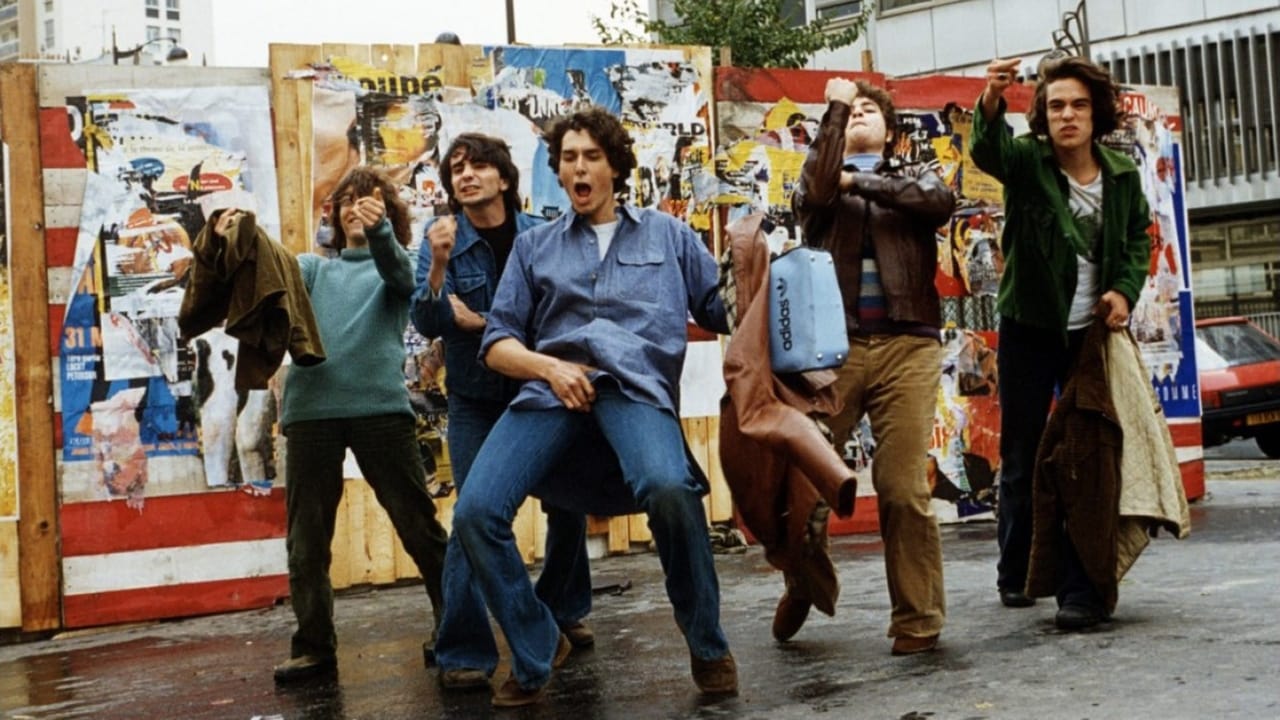
What immediately strikes you is the film’s vibrant recreation of mid-70s Paris. It’s not just the meticulously curated soundtrack pulsating with rock, funk, and folk, or the period-perfect details in fashion and setting; it’s the feeling. There’s a palpable sense of youthful rebellion simmering against a backdrop of lingering post-’68 political awareness, sexual discovery, casual drug use, and the intense, almost suffocating bonds of teenage friendship. Klapisch captures the listlessness, the sudden bursts of passion, the earnest debates about changing the world, and the petty squabbles with an immediacy that feels almost documentary-like.

Birth of a Generation
Le Péril Jeune is perhaps most notable today for launching a significant wave of French talent. This was the film that truly introduced Romain Duris to the world. As the charismatic, literature-loving Tomasi, even in flashback, he possesses an undeniable star quality – a blend of vulnerability, arrogance, and restless energy that makes his eventual fate feel both tragic and somehow inevitable. Watching him here, raw and untested, is a fascinating glimpse of the versatile actor he would become. Alongside him, Vincent Elbaz (Chabert), Nicolas Koretzky (Maurice), Julien Lambroschini (Bruno), and Joachim Lombard (Léon Rouvel) form a believable, fractious unit. Their interactions crackle with the easy intimacy and sudden tensions that define adolescent male friendships. There's an unpolished authenticity to their performances, a sense that Klapisch encouraged improvisation and captured genuine moments of connection and conflict.
Interestingly, the film itself had humble beginnings. It was originally commissioned as a 60-minute television film for the Franco-German channel Arte, part of a series themed around high school experiences ("Les Années Lycée"). Shot on a tight budget (reportedly around 7 million Francs, roughly €1 million), its unexpected power and resonance led to critical acclaim and festival buzz, ultimately prompting a successful theatrical release in France. It became a sleeper hit, a word-of-mouth phenomenon that deeply connected with audiences who saw their own youthful experiences reflected on screen, turning it into something of a cult classic, particularly for the generation it depicted and those who followed. That trajectory from small-screen assignment to cinematic touchstone speaks volumes about the raw nerve it struck.

The Perils of Looking Back
The film doesn't shy away from the "peril" of its French title – The Young Peril. The characters are often reckless, experimenting with drugs, sex, and political action with a naive bravado that foreshadows later troubles. There’s an undercurrent of danger beneath the youthful exuberance, a sense that these formative experiences, while exhilarating, also sow the seeds of future disillusionment and loss. Tomasi’s tragic overdose isn’t just a plot point; it’s the grim culmination of a path walked with more passion than caution.
The contrast between the vibrant 1975 flashbacks and the muted, melancholic tones of the 90s framing story is where the film finds its deepest emotional power. Seeing the surviving friends grapple with the memory of Tomasi, and by extension, their own lost youth, is profoundly moving. They are forced to confront not just who Tomasi was, but who they were, and how far they've drifted from those idealistic, hormone-fueled kids. Doesn't that echo a question many of us ask ourselves as the years pile up? What remains of the person we were at seventeen?
Final Reel
Le Péril Jeune isn't a flashy film. Its TV origins are occasionally apparent in its visual style, favoring intimacy over spectacle. But its strength lies in its emotional honesty, its superb ensemble cast led by a magnetic young Duris, and Klapisch's insightful direction, which even early in his career (he'd later give us the much-loved L'Auberge Espagnole (2002) and its sequels) showed a remarkable sensitivity to character and atmosphere. It captures the specific intoxication of youth – the feeling that anything is possible, that friendships are eternal, that the world is yours for the taking – and contrasts it heartbreakingly with the quieter realities of adult life. It avoids easy sentimentality, offering instead a nuanced, affecting portrait of memory, loss, and the indelible mark our formative years leave upon us. For anyone who came of age navigating similar currents of rebellion and discovery, or simply appreciates authentic, character-driven storytelling, this is a gem worth rediscovering.
Rating: 8/10 - This rating reflects the film's powerful emotional core, exceptional breakout performances, and its authentic capture of a specific time and the universal experience of youth. While its technical aspects might reflect its TV movie origins, its thematic depth and lasting resonance make it a standout piece of 90s European cinema, justifying a strong score for its impact and honesty.
It leaves you contemplating the ghosts of your own past, not with regret, perhaps, but with a quiet understanding of how those vibrant, reckless days shaped the person holding the remote control today.