There's a peculiar flatness to the suburban landscape where Graham Young conducts his lethal experiments, a beige-and-brown world of ordered gardens and net curtains that seems almost designed to stifle anything vibrant or unusual. Yet, behind the unassuming facade of a terraced house in Neasden, London, a chillingly singular obsession takes root. The Young Poisoner's Handbook (1995) doesn't just recount the facts of a true crime; it plunges us into the disturbingly placid mind of its perpetrator, forcing us to confront the banality that can accompany profound darkness. It’s a film that, once slid into the VCR back in the day, left a residue far more potent than mere static cling.
An Ordinary Monster
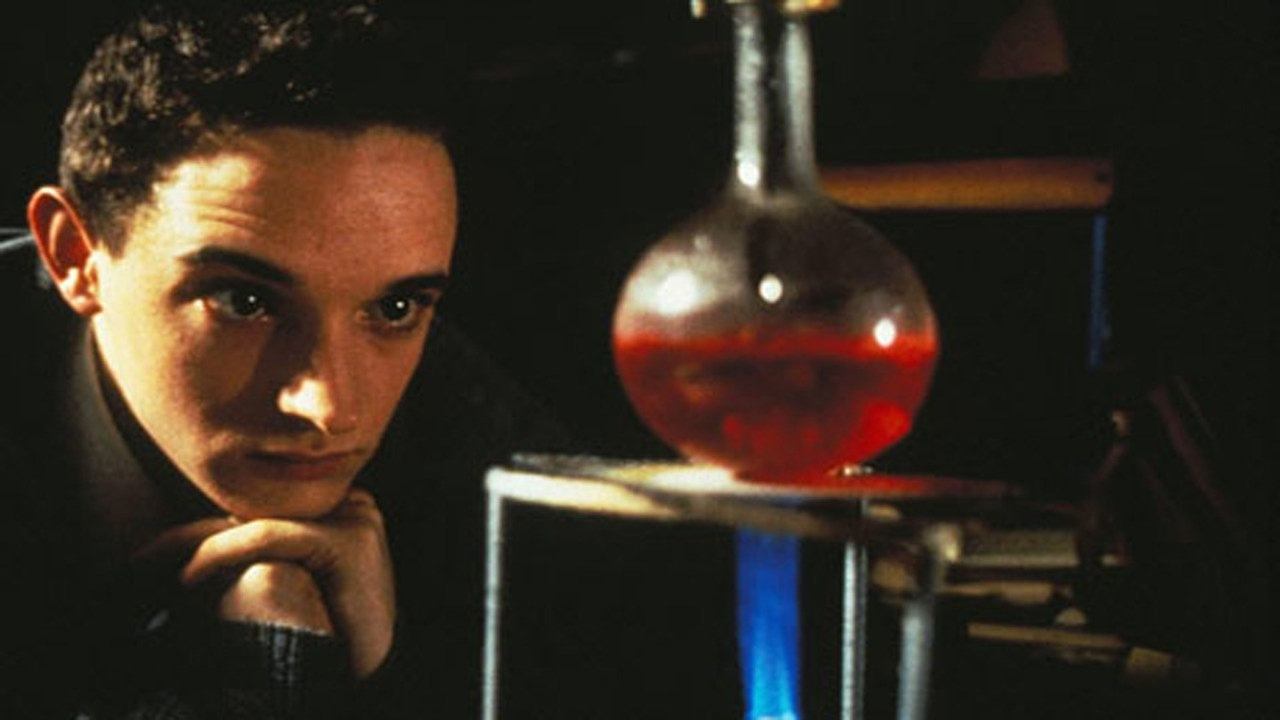
What strikes you immediately, and lingers long after, is the performance of Hugh O'Conor as Graham. Many might remember O’Conor from his incredibly moving turn as the young Christy Brown in My Left Foot (1989), making his portrayal here all the more remarkable for its absolute contrast. His Graham Young isn't a cackling villain or a tormented soul visibly wrestling with demons. Instead, O'Conor delivers a performance of unnerving stillness and quiet conviction. Graham approaches poisoning with the detached curiosity of a scientist, his voiceover narration clinical and precise, even when describing horrific acts visited upon his own family. There's a politeness, an almost eerie normality to his surface interactions, that makes his secret life all the more terrifying. He doesn't seem to hate his victims; they are merely variables in his ongoing, life-consuming experiment with toxicity. It’s this lack of conventional malice that truly chills – how do you understand evil when it presents itself with such calm rationality?
Beneath the Surface
Director Benjamin Ross, making a striking feature debut here (co-writing with actor Jeff Rawle, perhaps best known to UK audiences from Drop the Dead Donkey), masterfully uses the film's visual style to amplify this central contrast. The period detail of late 60s/early 70s Britain is meticulously recreated – the drab interiors, the specific textures of clothing and furniture, the slightly washed-out colour palette. It all contributes to an atmosphere that feels both authentic and stiflingly mundane. Ross rarely resorts to overt stylistic flourishes to signal horror. Instead, the horror arises from the juxtaposition: Graham meticulously recording dosages and symptoms in his notebooks while his stepmother, Molly (a wonderfully grounded Ruth Sheen), suffers agonizingly nearby. The camera often observes Graham with a similar detachment to his own worldview, making the audience uncomfortable witnesses rather than participants in melodrama.
A Bitter Draught of Comedy
Navigating the treacherous terrain of dark comedy based on true events is always a high-wire act. The Young Poisoner's Handbook manages it with unsettling poise. The humour, when it surfaces, is as dry and toxic as Graham's favoured thallium. It arises not from slapstick or witty repartee, but from the sheer absurdity of Graham's clinical focus amidst domestic life, or the oblivious reactions of those around him who fail to see the monster in their midst. Later, when Graham finds himself in an institution under the observation of the initially intrigued Dr. Zeigler (played with compelling intellectual vanity by the great Antony Sher), the film explores the chilling ease with which Graham can manipulate systems and expectations. It’s never laugh-out-loud funny; it’s the kind of humour that catches in your throat, born from disbelief and discomfort.
Retro Realities and Disturbing Details
The film's basis in the true story of Graham Frederick Young, the "Teacup Poisoner," lends it a particular weight. Ross and Rawle stick surprisingly close to the known facts of Young's life, from his early experiments on his family to his later poisoning spree at a photographic supply company after his release from Broadmoor Hospital. While details are naturally dramatized, the core narrative remains disturbingly accurate. This fidelity anchors the film, preventing it from tipping into outright exploitation. It wasn’t a huge box office smash, naturally, given its challenging subject matter, but The Young Poisoner's Handbook quickly found its audience on home video, becoming a quintessential 90s cult classic – the kind of tape passed between friends with a whispered warning about its unsettling power. Its premiere in the Directors' Fortnight section at the 1995 Cannes Film Festival signalled its artistic merit early on. The production itself embraced a certain grim authenticity, shooting in locations that evoked the specific London suburban feel crucial to the story's atmosphere. There are no flashy effects here; the horror is psychological, rooted in performance and implication.
The Young Poisoner's Handbook isn't an easy watch, nor should it be. It resists simple explanations for Graham's actions, offering instead a portrait of obsession that is as fascinating as it is repellent. It forces us to look at the familiar – the suburban home, the workplace tea round – and imagine the unimaginable horrors that might lurk just beneath the surface. What does it say about our ability to truly know those around us? And how thin is the veneer of normality that separates order from chaos?
Rating: 8/10
This score reflects the film's masterful control of tone, its chilling central performance, and its success in creating a deeply unsettling yet compelling character study. It doesn't offer easy answers or comfortable viewing, deliberately keeping the audience at a distance while simultaneously drawing them into Graham's singular, toxic worldview. A bold, intelligent, and disturbing piece of 90s British cinema that earns its cult status.
It’s a film that doesn’t just depict poisoning; it feels, in its own quiet way, rather poisonous itself, leaving a strange and uncomfortable aftertaste that’s hard to shake.