Okay, settle in, fellow tape travelers. Remember those moments, maybe late at night, flipping through channels or browsing the stranger corners of the video store, when something utterly unexpected flickered onto the screen? Something that wasn't an explosion-filled action flick or a teen comedy, but a piece of pure, hypnotic visual poetry? That’s the feeling Zbigniew Rybczyński’s 1981 animated short, Tango, evokes. It’s less a story and more a meticulously choreographed ballet of the mundane, unfolding within the confines of a single, unremarkable room.
### The Unfolding Room
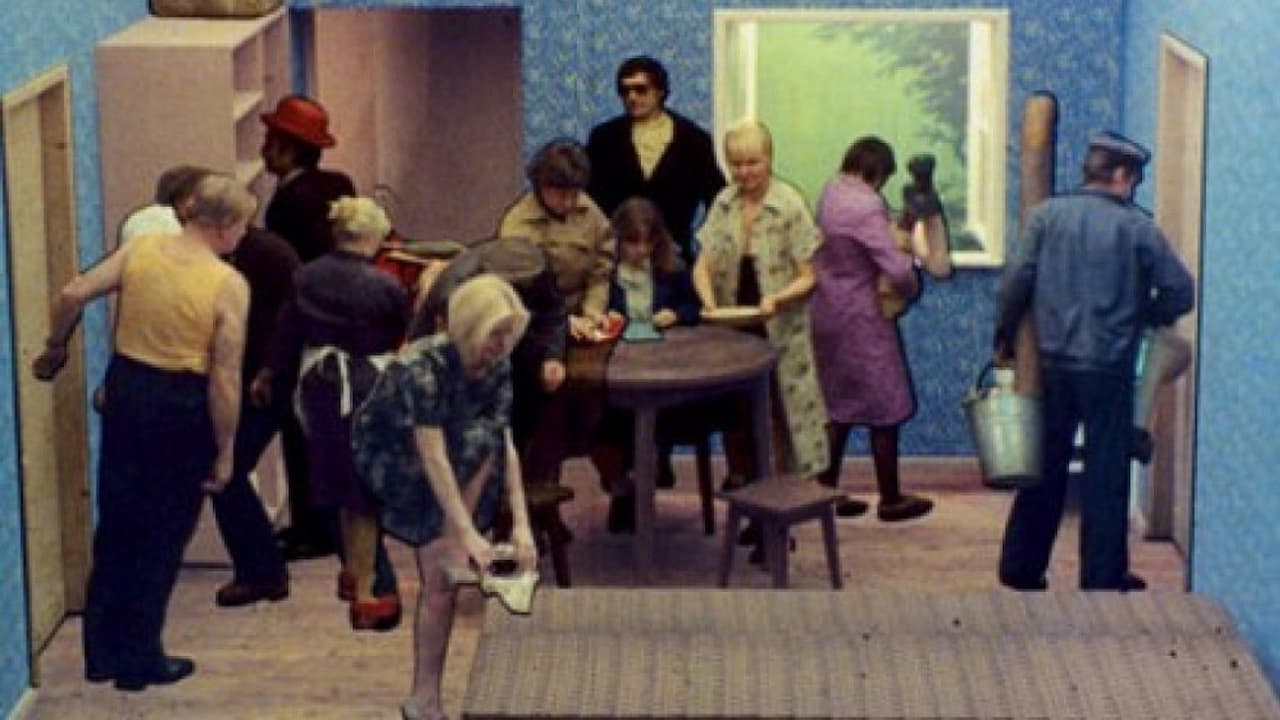
What begins simply – a ball bouncing through an open window into an empty room – gradually escalates into a dense tapestry of human activity. A boy retrieves the ball. A woman changes her baby. A man leaves his clothes. Another picks them up. A thief steals a package. A couple embraces. Each character enters, performs a specific, repetitive action, and then loops, seemingly unaware of the others piling into the same physical space. Rybczyński orchestrates this accumulation with breathtaking precision. There’s no dialogue, no traditional plot, just the relentless rhythm of overlapping lives, each tracing its path through the increasingly crowded frame. It's a concept that sounds simple on paper but becomes utterly mesmerizing in execution.
### A Feat of Patience and Vision
To truly appreciate Tango within the context of its time – pre-digital compositing, remember – is to grasp the sheer audacity of its creation. Rybczyński employed a painstaking technique involving optical printing and thousands of hand-drawn mattes. Essentially, he filmed each character performing their loop separately against a bluescreen (or similar) and then meticulously combined these individual film strips onto a single piece of film stock, one layer at a time. Imagine the planning required! Every movement had to be perfectly timed to avoid visual collision (even as the characters seem oblivious), ensuring each loop integrated seamlessly into the growing visual density. This wasn't CGI; this was pure, analog artistry born from incredible patience and a singular vision. It's rumored the process took months of near-continuous work in the cramped confines of the Polish animation studio Se-ma-for. The result is a seamless illusion, a single room impossibly containing dozens of intersecting, repeating lives.
### Echoes in the Loop
What does it all mean? That's the question Tango gently nudges us towards, rather than answering directly. Is it a commentary on the isolating routines of modern life, where individuals move through shared spaces but remain locked in their own repetitive cycles? Perhaps it speaks to the density of human history, layers upon layers of experience occurring in the same locations, each generation leaving its faint echo. Filmed in Poland during a tense period before the imposition of martial law, some read a subtle political dimension into it – the feeling of being trapped, observed, going through motions within a confined system. Rybczyński himself was often coy about definitive interpretations, preferring the viewer to find their own meaning in the hypnotic visual dance. Doesn't the film capture that feeling we sometimes get, overwhelmed by the sheer weight of humanity and its endless, often unseen, dramas playing out around us? The power lies in its ambiguity and the resonance of its central visual metaphor.
### An Unlikely Oscar Winner
Remarkably, this avant-garde Polish animation snagged the Academy Award for Best Animated Short Film in 1981. It's a testament to the film's undeniable technical brilliance and unique power, cutting through perhaps more conventional contenders. Rybczyński, who later directed visually inventive music videos like Art of Noise's "Close (to the Edit)" and Simple Minds' "All the Things She Said," cemented his reputation as a master visualist with Tango. His Oscar night, however, became infamous – stepping outside for a smoke after his win, his limited English and lack of a re-entry ticket reportedly led to an altercation with security and a brief, bewildering arrest. A truly bizarre footnote to cinematic history, highlighting the often strange journey of art from creation to recognition.
Tango isn't a film you watch for escapism in the usual sense. It’s a piece you experience. It pulls you into its rhythm, its accumulating complexity becoming a visual puzzle and a philosophical prompt. Finding something like this on VHS, perhaps on a compilation tape or recorded off a late-night arts program, felt like uncovering a secret transmission from another dimension of filmmaking. It was proof that cinema could be more than just narrative; it could be pure visual rhythm and thought-provoking artistry.
Rating: 9/10
This score reflects the film's groundbreaking technical achievement, its enduring artistic merit, and its powerful, ambiguous core concept. It's a near-perfect execution of a unique vision, losing perhaps a single point only because its experimental nature might not offer the conventional "entertainment" some viewers seek. However, as a piece of influential animation history and a mesmerizing visual poem, its brilliance is undeniable.
Tango lingers not as a story told, but as a feeling absorbed – the strange, beautiful, and sometimes overwhelming dance of life condensed into a single, looping room. A true gem from the era before digital trickery made the impossible commonplace.