Okay, settle in, grab a warm drink, maybe dim the lights a bit. Remember those hefty VHS tapes, the ones with the colourful covers promising epic stories that spanned continents and emotions? Tonight, let's rewind to one such tape, a fixture in many rental stores and VCRs back in '97: Subhash Ghai's ambitious cross-cultural drama, Pardes. It wasn't just a movie; it felt like an event, a grand statement wrapped in glorious song and dance.
### The Heart's True Home
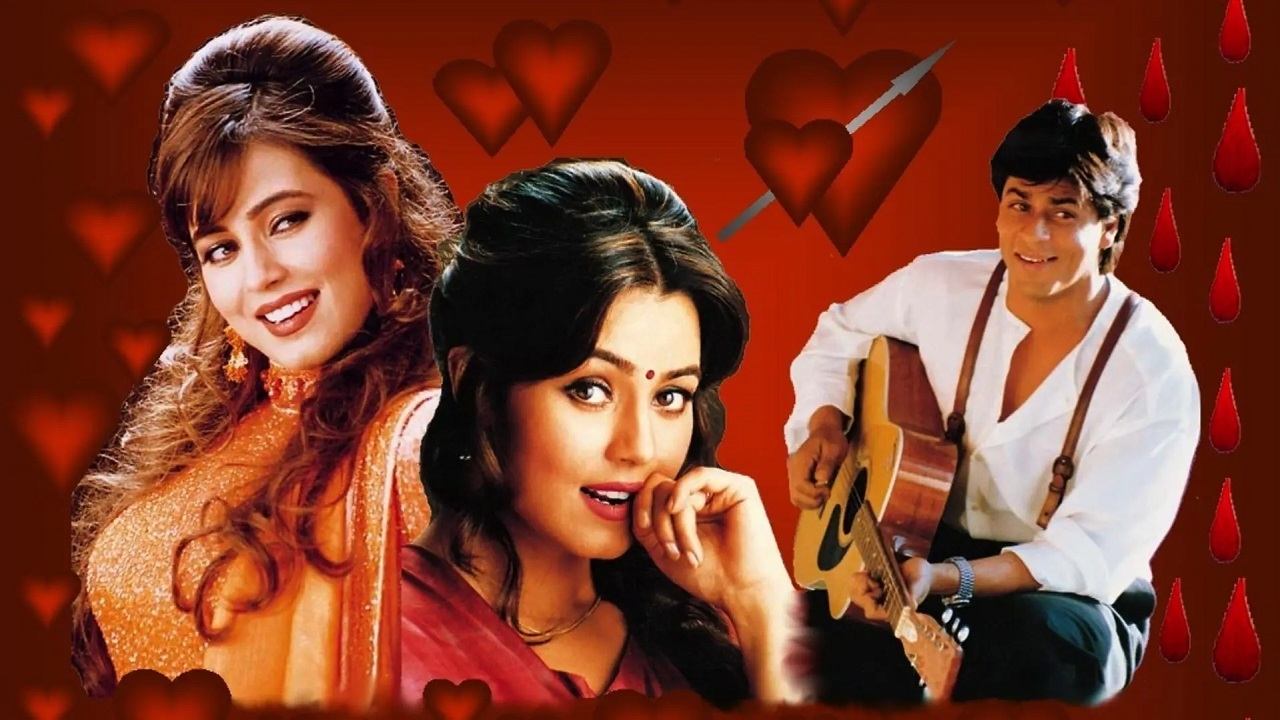
What truly defines belonging? Is it the soil beneath our feet, the land of our birth, or the values we carry within us, regardless of geography? Pardes (meaning "Foreign Land") plunges headfirst into this complex question, presenting a narrative tapestry woven with threads of idealism, disillusionment, and the yearning for connection. The film centers on Kishorilal (Amrish Puri), a successful, deeply traditional Indian businessman settled in America, who clings fiercely to the idealized virtues of his homeland. He seeks a culturally "pure" Indian bride for his thoroughly Americanized son, Rajiv (Apurva Agnihotri), and finds his ideal in the innocent Ganga (Mahima Chaudhry), hailing from a rustic village. Bridging these two worlds is Arjun (Shah Rukh Khan), Kishorilal's loyal foster son, a man who understands both the allure of the West and the soul of India. It's a classic setup, ripe for exploring the friction between tradition and modernity, east and west.
### A Star is Born, A Star Consolidates

Watching Pardes today, one is immediately struck by the powerhouse performances, particularly considering it was a debut for one and a crucial consolidating role for another. Amrish Puri, a titan of Indian cinema, embodies Kishorilal with unwavering conviction. He isn't just a caricature of an NRI (Non-Resident Indian) patriarch; Puri imbues him with a palpable love for his motherland, even if it's viewed through rose-tinted glasses. His booming voice and commanding presence anchor the film's ideological core.
Then there's Mahima Chaudhry. Plucked from relative obscurity by Subhash Ghai (who famously has an eye for discovering talent – he even changed her name from Ritu for the screen), she delivers a remarkably assured debut as Ganga. She convincingly portrays the character's journey from wide-eyed village belle, initially mesmerized by the West's glamour, to a woman discovering her own strength and discerning the difference between surface shine and inner substance. It's a performance that resonated deeply with audiences at the time, making her an overnight sensation. A fascinating piece of trivia: Ghai reportedly auditioned over 3,000 girls before finding his Ganga!
And Shah Rukh Khan... ah, SRK. This wasn't the usual ultra-rich romantic lead he often played. Arjun is more grounded, observant, a sort of cultural custodian caught between his loyalty to Kishorilal and his growing feelings for Ganga, whom he sees being mismatched with the brash Rajiv. Khan brings a sensitivity and earnestness to Arjun that makes him the film's emotional compass. Pardes was significant in showcasing his versatility beyond the conventional hero mold, allowing him to play a character defined more by integrity and quiet understanding than flamboyant gestures. It further cemented his status as the king of romance, but with added depth.
### Ghai's Grand Canvas and That Soundtrack!
Subhash Ghai, often called the "Showman" of Bollywood, directs with his characteristic flair for spectacle and high emotion. The contrast between the vibrant, earthy Punjab villages and the sleek, impersonal landscapes of North America (locations included spots in Los Angeles, Las Vegas, and Vancouver doubling for the US) is visually striking, underlining the cultural chasm. Ghai doesn't shy away from melodrama – it's baked into the narrative, reflecting the high stakes of cultural identity and personal values. Some might find it heightened now, but back in the 90s, this grand emotional scale was Bollywood blockbuster filmmaking. Ghai even makes his signature fleeting cameo, a little wink to eagle-eyed viewers.
And the music... oh, the music! The soundtrack by the legendary duo Nadeem-Shravan wasn't just popular; it was colossal. Songs like "I Love My India," "Do Dil Mil Rahe Hain," and "Yeh Dil Deewana" became anthems, blasted from cassette players everywhere. They weren't just tunes; they were narrative pillars, expressing patriotism, burgeoning love, and internal conflict. Remember popping that tape into the car stereo or waiting eagerly for the songs during the movie? Nadeem-Shravan's score perfectly captured the film's blend of traditional Indian melodies and more contemporary sounds, mirroring the central theme. The album was one of the best-selling Bollywood soundtracks of 1997, a testament to its immediate and lasting connection with the audience. The film itself rode this wave, becoming a major box office success – reportedly made on a budget of around ₹10 crore (approx. $2.8 million USD then), it grossed over ₹40 crore (approx. $11.3 million USD then) worldwide, achieving "Golden Jubilee" status (running in theatres for 50 weeks).
### Echoes of the 90s
Watching Pardes now feels like opening a time capsule to the specific socio-cultural anxieties and aspirations of 90s India and its diaspora. The film tapped into a potent vein of patriotism and the complex feelings of NRIs navigating their identity between two cultures. It presented a narrative that, while perhaps simplifying complex issues, resonated powerfully with its audience by championing perceived traditional values against Western influence. Does Ganga's choice ultimately feel empowering or restrictive? Does the film romanticize the homeland to an unrealistic degree? These are questions worth pondering, reflecting how our perspectives might have shifted since first watching that VHS tape.
The film's portrayal of the West, particularly through Rajiv and his circle, leans heavily on stereotypes – indulgence, lack of respect, moral ambiguity. While serving the narrative's purpose, it lacks nuance. Yet, the central conflict – the struggle to reconcile heritage with a new environment, the search for genuine connection over superficial attraction – remains relatable.
Rating: 7.5/10
This score reflects Pardes's undeniable impact and strengths within its specific time and context. The powerhouse performances, particularly from the core trio, are compelling. Subhash Ghai's confident direction delivers spectacle and emotion, and the Nadeem-Shravan soundtrack is simply iconic, elevating the film significantly. It successfully captured a cultural moment and delivered a memorable cinematic experience. Points are deducted for the sometimes heavy-handed melodrama, the somewhat simplistic portrayal of Western culture, and certain plot elements that feel dated. However, its narrative ambition, emotional core, and sheer nostalgic power earn it a solid place in 90s Bollywood history.
Pardes remains a fascinating watch, a film that wears its heart, its patriotism, and its epic scope proudly on its sleeve. It’s a reminder of a time when Bollywood blockbusters tackled big themes with grand gestures, leaving audiences humming the tunes and debating the dilemmas long after the credits rolled and the VCR clicked off. What lingers most, perhaps, is that central question about where – and what – truly constitutes home.