It’s a curious thing when a director known for tight, shadowy thrillers turns their lens towards the intricate, often painful dynamics of family life. That was the immediate thought that struck me revisiting Carl Franklin’s One True Thing (1998). Here was the filmmaker who gave us the simmering tensions of One False Move (1992) and the stylish period noir of Devil in a Blue Dress (1995), now helming a story adapted from Anna Quindlen’s deeply personal novel about a daughter forced to confront the unvarnished reality of her parents' lives. It felt like an unexpected swerve back then, and watching it now, that choice feels precisely right, bringing a clear-eyed lack of sentimentality to a story brimming with potential melodrama.
### A Daughter's Reluctant Return
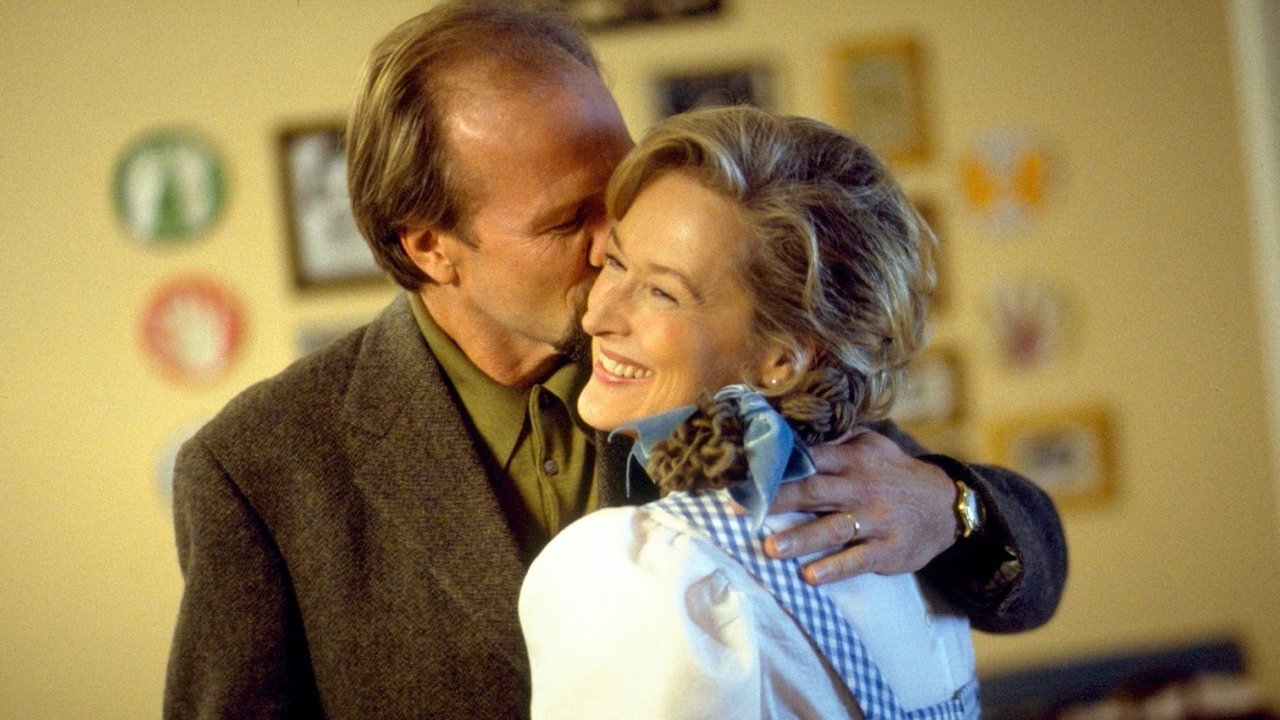
The setup is deceptively simple, yet resonates with a familiar, uncomfortable weight. Renée Zellweger, still radiating the relatable charm from Jerry Maguire (1996) but proving her dramatic range, plays Ellen Gulden, an ambitious young magazine writer carving out her own life in New York City. She views her parents from a distance – her father, George (William Hurt), a respected literature professor and minor literary figure, and her mother, Kate (Meryl Streep), the seemingly perfect, endlessly accommodating homemaker. Ellen idolizes her intellectual father and holds a certain affectionate condescension for her mother’s domestic sphere, seeing it as small, unambitious, perhaps even a waste.
But life, as it often does, throws a devastating curveball. Kate is diagnosed with cancer, and George, seemingly incapable of managing the household or his wife's care, pressures Ellen to put her career on hold and come home. It’s a demand wrapped in familial obligation, and Ellen’s reluctant return forces her into the very domestic world she disdained, becoming her mother's caregiver and, inevitably, seeing both her parents stripped of their carefully constructed facades.
### Beyond the Surface
What unfolds isn't just a story about illness; it’s a profound exploration of perception versus reality within a family unit. Franklin’s direction, aided by Declan Quinn’s sensitive cinematography (known for his work on films like Leaving Las Vegas), avoids easy emotional cues. The film allows Ellen’s perspective to gradually, painfully shift. She discovers Kate isn't just a collection of recipes and household tips, but a woman of hidden intelligence, quiet sacrifices, and deep, perhaps unacknowledged, disappointments. We learn Kate had her own aspirations, subtly diverted or subsumed by her husband's career and ego. It’s a quiet tragedy playing out behind cheerful curtains.
This is where the performances truly anchor the film, elevating it beyond a standard "disease-of-the-week" narrative often found on television back then. William Hurt is exceptional as George, embodying that specific kind of charming intellectual narcissism. He’s not overtly villainous, but his selfishness, his reliance on Kate’s quiet management of his life, and his inability to cope when that support system falters, are laid bare. It’s an uncomfortable, truthful portrayal of a man who loves his family but perhaps loves his own image more.
Renée Zellweger carries the emotional core of the film as the audience's surrogate. Her initial resentment, her frustration with the domestic tasks, her slow dawning realization of her mother’s true worth and her father’s flaws – it all feels achingly authentic. You see the sophisticated New Yorker crack as she confronts the messy, unglamorous reality of caregiving and the dawning, complex love and understanding for her mother.
### Streep's Quiet Power
And then there’s Meryl Streep. Earning her 11th Academy Award nomination for this role, she delivers a performance of astonishing subtlety. Kate could easily have become a saintly martyr or a caricature of bubbly domesticity. Instead, Streep inhabits her with a lived-in weariness beneath the persistent cheerfulness. The small gestures, the forced smiles that don’t quite reach her eyes, the moments of vulnerability when the facade slips – it’s masterful work. There's a story that Streep meticulously researched and learned various domestic skills for the role, wanting Kate’s competence in her own sphere to feel utterly genuine, a quiet testament to the character’s often-overlooked strengths. It’s this dedication that makes Kate’s plight, and Ellen’s eventual recognition of it, so deeply moving.
It’s fascinating to remember that this intimate drama, shot largely on location in suburban New Jersey, landed amidst a late 90s landscape often dominated by bigger, louder films. It wasn't a blockbuster – pulling in around $27 million worldwide against a reported $23-30 million budget – but its impact felt significant for those who sought out character-driven stories. It was a film you rented from the "Drama" section, perhaps expecting something straightforwardly sad, only to find yourself grappling with more complex questions about sacrifice, resentment, and the often-painful process of truly seeing one's parents as flawed human beings.
### Lasting Reflections
One True Thing doesn't offer easy answers or neat resolutions. It lingers precisely because it acknowledges the ambiguities and compromises inherent in family life. It asks us to consider the hidden contributions, the quiet sacrifices that often go unnoticed, particularly in generations where roles were more rigidly defined. What constitutes a meaningful life? Is public achievement the only measure, or is there profound value in the connections forged and sustained within the home? The film leaves you pondering these questions long after the credits, and perhaps re-evaluating your own family narratives.
Rating: 8.5/10
Justification: While the pacing is deliberate and the subject matter inherently melancholic, the film is elevated by Carl Franklin’s sensitive, unflashy direction and three powerhouse performances that feel utterly authentic. Streep's Oscar-nominated turn is a masterclass in subtlety, Zellweger provides a relatable emotional anchor, and Hurt crafts a complex, uncomfortably familiar patriarch. Its refusal to sentimentalize difficult family truths gives it lasting power.
Final Thought: A quiet gem from the late VHS era that reminds us that sometimes the most profound discoveries are made not in chasing ambition, but in the difficult, illuminating act of coming home.