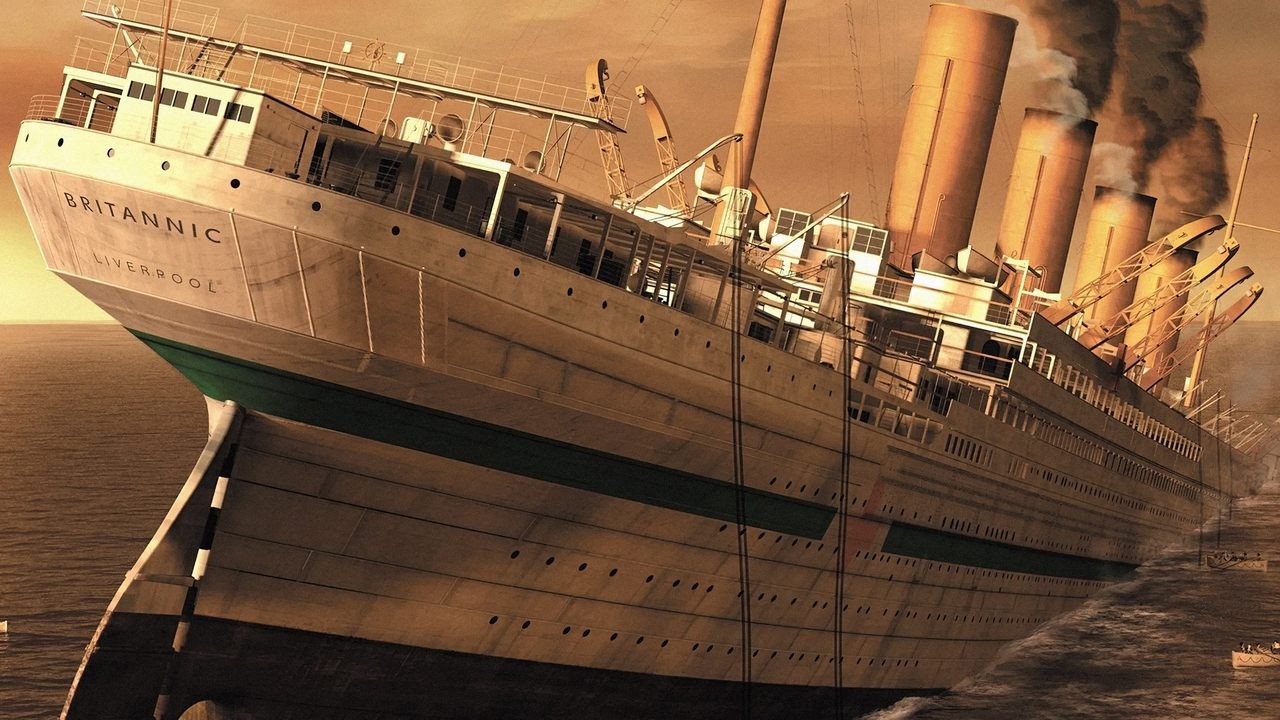
The cold, grey expanse of the Aegean Sea in wartime. A white hull, marked with vast red crosses, promises sanctuary but sails under the constant shadow of unseen threats. HMHS Britannic, sister to the infamous Titanic, wasn't just a vessel of healing; she was a floating contradiction, a symbol of mercy adrift in a world bent on destruction. The 2000 television film Britannic attempts to capture this precarious existence, but plunges it into the murky depths of espionage fiction, creating a curious, sometimes chilling, often awkward artifact from the turn of the millennium. It arrived just as the VHS era was waning, feeling both like a product of its time and a throwback to earlier, more straightforward TV movie thrillers.
Shadows on the Promenade Deck
Directed by the prolific Brian Trenchard-Smith, a name synonymous with Ozploitation gems (Turkey Shoot, Dead End Drive-In) and energetic, often tongue-in-cheek action, Britannic presents a fascinating clash of sensibilities. The premise injects pure pulp into historical tragedy: Vera Campbell (Amanda Ryan), a British intelligence operative haunted by surviving the Titanic sinking (a fictional backstory adding personal stakes), boards the Britannic disguised as a governess. Her mission? To uncover a German spy believed to be aboard, ready to sabotage the hospital ship to discredit the Allies. This immediately casts a pall over the vessel’s supposed neutrality, turning corridors and cabins into potential stages for clandestine conflict. The inherent vulnerability of a ship teeming with wounded soldiers becomes fertile ground for suspense, even if the execution sometimes falters under TV movie constraints.
A Tangled Web of Intrigue
Amanda Ryan carries the weight of the central plot, portraying Vera with a steely determination masked by societal propriety. Her investigation leads her through a predictable but functional gallery of suspects, while simultaneously developing a connection with the ship's chaplain, Reverend Baker (Edward Atterton). Their burgeoning romance provides the requisite emotional core, though it occasionally dilutes the tension of the spy hunt. The film tries to build atmosphere through whispered conversations in shadowed corners and near-miss discoveries, leaning into the paranoia of wartime intelligence. Does it achieve the nail-biting suspense of classic espionage thrillers? Not quite. The pacing can feel uneven, caught between the demands of the spy plot, the burgeoning romance, and the inevitable disaster looming on the horizon. Yet, there's a certain earnestness to its efforts that resonates with the straightforward storytelling common in the late 90s/early 2000s television landscape.
Resourceful Mayhem
Knowing Brian Trenchard-Smith is at the helm raises certain expectations. While Britannic lacks the gonzo energy of his more infamous works, his knack for resourceful filmmaking surfaces, particularly in the action sequences and the climactic sinking. Faced with a television budget – a far cry from the $200 million James Cameron commanded for Titanic (1997) just a few years prior – Trenchard-Smith employed a mix of techniques. Reports suggest the production utilized miniatures previously built for the 1980 film Raise the Titanic, alongside practical effects and what now looks like very early, somewhat rudimentary CGI. There's an undeniable charm, even a strange sort of comfort, in watching these tangible effects work, a hallmark of the era VHS Heaven celebrates. The chaos of the sinking, while heavily fictionalized (the real Britannic sank in under an hour due to a likely mine explosion exacerbated by open portholes, not elaborate sabotage), is staged with a certain B-movie gusto. Doesn't that practical model work, tilting precariously against a studio backdrop, still evoke a specific kind of disaster movie thrill?
Anchors of Familiarity
Lending the production a touch of old-school Hollywood glamour is Jacqueline Bisset as Lady Lewis, a wealthy passenger whose presence adds a dash of upper-class drama. While her role isn't substantial, Bisset brings an undeniable screen presence. Also notable is John Rhys-Davies (instantly recognizable from Raiders of the Lost Ark and later The Lord of the Rings) in a smaller role as Captain Bartlett. These familiar faces provide comforting anchors amidst the espionage and impending doom, even if the script doesn't always give them material worthy of their talents. Their inclusion feels like a nod to the kind of casting common in the star-studded disaster films of the 70s, another layer to Britannic's somewhat anachronistic appeal.
History Adrift
It’s crucial to address the historical liberties taken. The central spy plot is entirely fabricated, a dramatic engine grafted onto the real tragedy. The film depicts sabotage, U-boat confrontations, and a far more protracted sinking sequence than what actually occurred. For history purists, this will undoubtedly rankle. Yet, viewed through the lens of a turn-of-the-century TV thriller aiming for entertainment rather than documentary accuracy, these changes become part of its identity. It wasn't aiming for A Night to Remember (1958); it was aiming for a thrilling slice of historical "what if?" fiction, perfectly suited for a Friday night rental or a late-night broadcast slot. The film even alters the ship's final moments for maximum dramatic effect, a common trope but one that feels particularly pronounced here.
Final Voyage
Britannic is a curious maritime concoction: part spy thriller, part disaster flick, part historical drama, all filtered through the constraints and sensibilities of a 2000 television movie. It doesn't fully succeed on any single front, feeling tonally disjointed at times and hampered by its budget and historical inaccuracies. Yet, it possesses a certain earnest charm and benefits from Brian Trenchard-Smith's ability to stage competent action, even on a smaller scale. The blend of practical effects and early CGI provides a distinct timestamp, placing it firmly at the cusp of changing cinematic technology. For fans of maritime stories, espionage tales, or simply the unique flavor of late-VHS-era TV movies, it offers a diverting, if flawed, experience. I remember catching this on TV long after its premiere, its blend of familiar disaster tropes and the added spy angle feeling both slightly daring and comfortably predictable.
Rating: 5/10
The score reflects a film that's competently made for its television origins and offers some B-movie thrills, particularly thanks to Trenchard-Smith's direction and the inherent drama of the setting. However, it's held back by significant historical inaccuracies, uneven pacing, and a script that juggles its different genre elements somewhat awkwardly. It doesn't quite deliver the suspense its premise promises, nor the emotional weight the real tragedy deserves.
Final Thought: Britannic remains a fascinating footnote, a relic from a time when the Titanic phenomenon still cast a long shadow and TV movies offered ambitious, if often imperfect, genre blends perfect for a late-night viewing fogged by nostalgia.