It starts, as many strange journeys do, on a train. A man nods off, drifts into that hazy space between waking and sleeping, and suddenly finds himself pursuing an alluring woman into a world constructed entirely of female figures, desires, judgments, and anxieties. Watching Federico Fellini's City of Women (1980) again after all these years feels less like revisiting a film and more like re-entering a particularly vivid, chaotic, and deeply personal dream – or perhaps nightmare, depending on your perspective. This wasn't the kind of tape you grabbed instinctively for a Friday night pizza party; finding it nestled in the 'Foreign Films' section of the video store often felt like unearthing something slightly forbidden, potentially baffling, but undeniably intriguing.
Into the Looking Glass
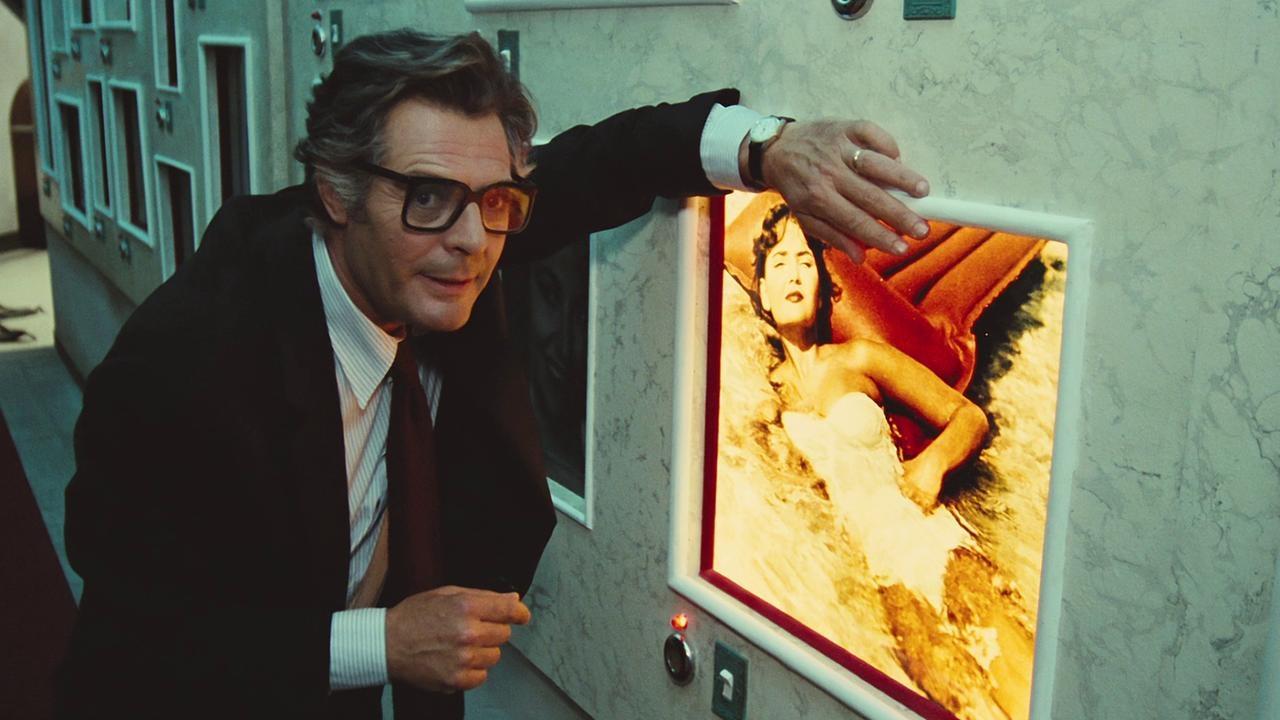
The man is Snàporaz, played with weary charm and perpetual bewilderment by the great Marcello Mastroianni, Fellini's cinematic alter ego, familiar to anyone who's spent time with masterpieces like 8½ (1963) or La Dolce Vita (1960). Almost immediately, Snàporaz stumbles from his pursuit into a sprawling hotel hosting a feminist convention. The atmosphere is overwhelming, a cacophony of voices, lectures, roller-skating delegates, and symbolic imagery. It's here the film sets its stall: this isn't a narrative in the conventional sense, but a phantasmagorical journey through the male psyche, specifically the anxieties of an aging Italian man confronting a world where women are asserting their own voices and power, often in ways that leave him feeling obsolete and confused. Does this initial disorientation mirror something of the cultural shifts happening as the 70s bled into the 80s? Perhaps.
Mastroianni: Adrift in a Female Sea
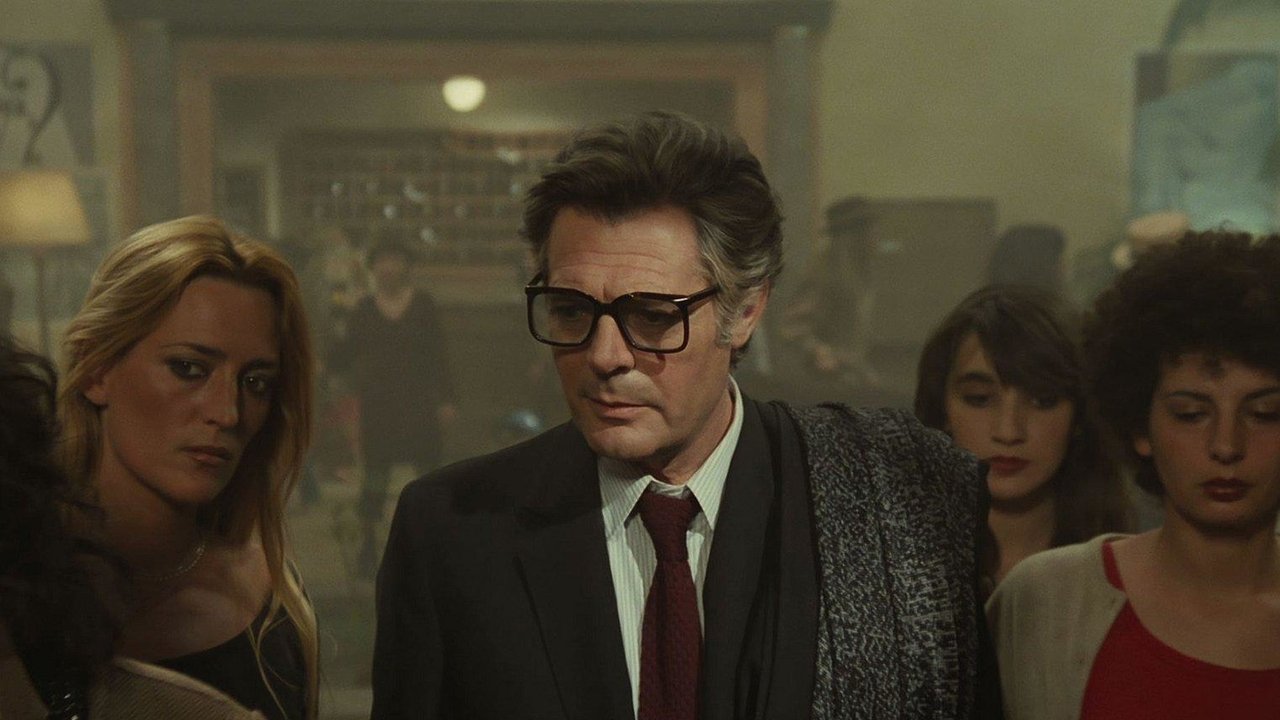
Mastroianni is the key, the relatable anchor in Fellini's swirling visual opera. His Snàporaz is not malicious, but rather passive, almost childlike in his pursuit of sensual gratification and his inability to comprehend the female perspectives surrounding him. He wanders through elaborate set pieces – a bizarre gymnasium, the sensual fortress of a hyper-masculineStrongman type (a critique of another kind of male archetype?), a dreamlike reunion with his own past loves – with an air of befuddled hope and occasional panic. It's a testament to Mastroianni's skill that Snàporaz remains sympathetic, even pitiable, rather than purely pathetic. He embodies the confusion of traditional masculinity adrift in changing tides, a theme Fellini explored repeatedly, but rarely with such direct, almost confrontational, surrealism.
Fellini's Carnival of the Psyche
Visually, City of Women is pure, uncut Fellini. Working with his longtime production designer Danilo Donati, the director crafts extraordinary, sprawling sets at Rome's legendary Cinecittà studios. The sheer scale is astonishing, particularly considering the film’s reported budget, which ballooned to around $12-14 million – a huge sum for an Italian production at the time. Every frame bursts with detail, often grotesque, sometimes beautiful, always theatrical. Think elaborate costumes, surreal architecture, and crowds teeming with Fellini-esque faces. The infamous sequence where Snàporaz rides a rollercoaster through projections of his past sexual encounters is both technically ambitious for its era and thematically potent, a literal ride through the labyrinth of male memory and desire. Fellini was known for developing ideas during shooting, and you feel that improvisational energy here; it’s less a tightly scripted narrative and more a series of associative leaps, like a mind trying to make sense of its own subconscious.
Echoes of Controversy
It's impossible to discuss City of Women without acknowledging its controversial reception. Released during a peak wave of feminist discourse, the film was accused by many critics of being misogynistic, a parade of female stereotypes viewed through a panicked male lens. Others argue it's actually a critique of that very lens, exposing the limitations and anxieties of the traditional male viewpoint (personified by Snàporaz/Fellini) when faced with female autonomy. Where does the truth lie? Like much of Fellini's work, it resists easy answers. The film doesn't offer a clear resolution or message; instead, it presents a complex, often uncomfortable, tapestry of images and encounters. It forces us to ask: Is this Fellini's view of women, or his depiction of Snàporaz's limited view? The ambiguity is part of its challenging nature.
A Strange VHS Artifact
Finding this on VHS back in the day was a different experience than renting, say, Raiders of the Lost Ark. It required a certain commitment. You knew you weren't getting straightforward entertainment. Instead, you were signing up for a visual feast that might leave you exhilarated, confused, perhaps even irritated, but rarely indifferent. It wasn't background noise; it demanded your attention, forcing you to navigate its strange logic alongside Snàporaz. Does its sometimes dated sexual politics clash with modern sensibilities? Absolutely. Yet, as a portrait of male anxiety and a testament to Fellini's singular, extravagant vision, it remains a fascinating artifact. There's a certain bravery, perhaps even recklessness, to its creation that feels distinctly of its time.
Rating: 7/10
City of Women is undeniably a Federico Fellini film – sprawling, self-indulgent, visually stunning, thematically challenging, and deeply personal. Marcello Mastroianni gives a typically brilliant performance as the bewildered centerpiece. The sheer ambition of the production and the unforgettable imagery earn it significant points. However, its episodic structure can feel meandering, and its sexual politics remain deeply problematic for many viewers, preventing it from reaching the heights of Fellini's earlier masterpieces. It’s a film that prompts more questions than it answers, less a cohesive statement and more a troubled, spectacular dream captured on celluloid.
What lingers most is that feeling of being adrift, the sense of a familiar world suddenly becoming alien and carnivalesque. Isn't that sometimes how looking back at the past feels, through the hazy lens of memory and changing times?