## The Long, Strange Trip to Eira: Reflecting on Calamari Union
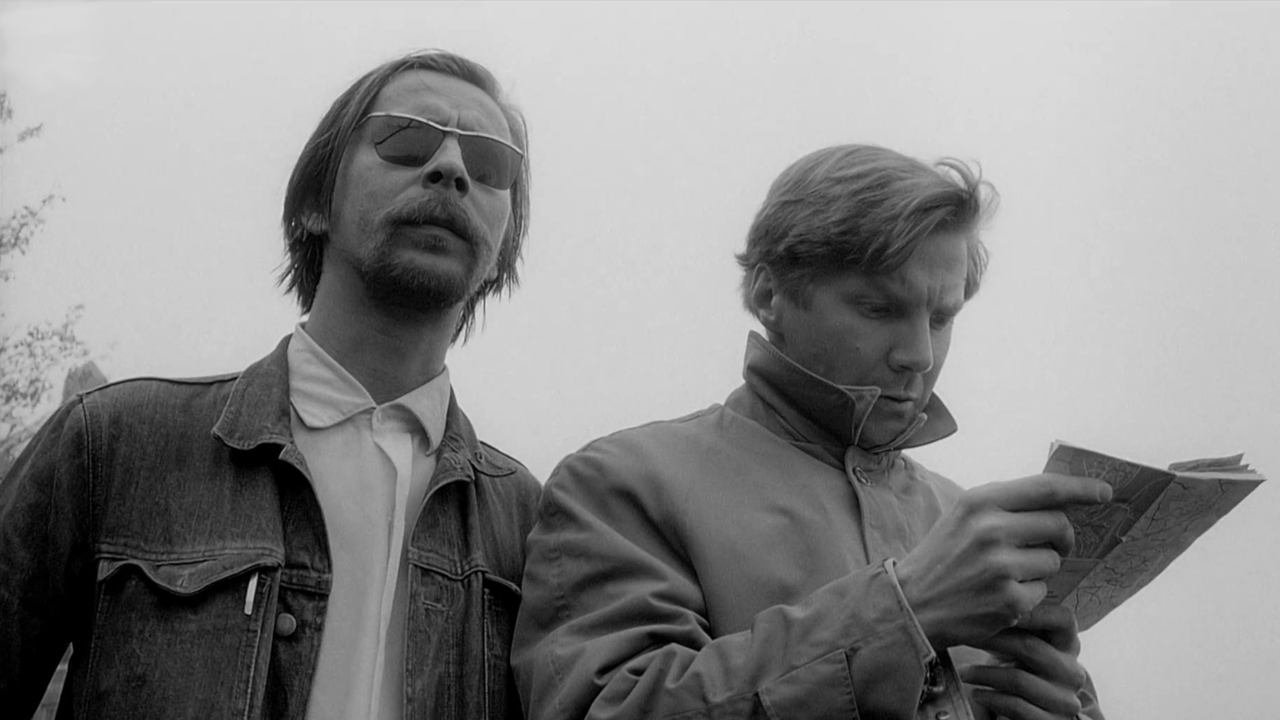
Some films lodge themselves in your memory not through bombast or spectacle, but through sheer, unforgettable strangeness. Aki Kaurismäki's 1985 venture, Calamari Union, is precisely that kind of film – a monochrome odyssey through the urban landscape of Helsinki that feels less like a conventional narrative and more like a deadpan existential joke whispered in a smoky bar late at night. It arrived on our shores, often relegated to the dustier corners of the video store's "Foreign Films" section, a cryptic title promising... well, who knew what? Finding it felt like unearthing a secret.
A Quest Most Peculiar
The premise is deceptively simple, almost absurdist fable: fifteen men, all but one inexplicably named Frank (the lone dissenter is Pekka), decide they've had enough of their dreary lives in the working-class Kallio district. Their goal? To escape to Eira, a neighbourhood perceived as greener, more sophisticated, a promised land just across the city. Their journey, however, becomes a labyrinthine crawl through the nocturnal city, fraught with bizarre encounters, philosophical non-sequiturs, and the steady attrition of their numbers. Does the destination even matter as much as the bewildering journey itself?
Kaurismäki, even early in his career here (following 1983's Crime and Punishment), establishes the signature style that would define his work: stark black-and-white cinematography that drains the world of frivolity, static camera shots that hold unflinchingly on his characters' impassive faces, and dialogue delivered with such profound flatness it becomes darkly hilarious. The Helsinki presented here isn't a tourist destination; it's a purgatorial landscape of rain-slicked streets, dimly lit bars, and anonymous apartment blocks, rendered beautifully bleak by cinematographer Timo Salminen, a long-time Kaurismäki collaborator.
The Many Faces of Frank
The casting is a roll-call of Finnish acting stalwarts and Kaurismäki regulars, including the unforgettable Matti Pellonpää (later the heartbreaking lead in The Match Factory Girl (1990)) and the versatile Kari Väänänen (who’d appear in Kaurismäki’s international hit Leningrad Cowboys Go America (1989)). It’s almost impossible, and perhaps pointless, to single out individual "Franks." They function as a collective entity, a mass of weary souls united by a name and a vague yearning. Their performances are studies in minimalist expression; a slight shift of the eyes or a barely perceptible sigh carries immense weight. It’s this unified front of laconic despair and absurd determination that gives the film its unique, hypnotic rhythm. Their shared lack of affect isn't wooden acting; it's a deliberate choice, reflecting a deep-seated ennui and a uniquely Finnish brand of stoicism pushed to its comical extreme.
Beneath the Absurdity
What are we to make of this parade of Franks? Is Calamari Union simply a surreal experiment, or is there more beneath the surface? The film certainly invites interpretation. The stark contrast between Kallio and Eira feels like a pointed commentary on class division within Helsinki, a theme Kaurismäki would consistently explore. The Franks' seemingly futile quest could be read as an allegory for the elusive nature of happiness, the search for meaning in a mundane world, or even the homogenizing pressures of modern life. Despite their shared name and goal, subtle differences emerge, and their individual fates diverge dramatically. Is conformity the ultimate trap, even when escaping perceived misery?
Kaurismäki masterfully blends this low-key philosophizing with moments of pure, unexpected visual poetry and bursts of rock and roll energy. The soundtrack, featuring Finnish rockabilly and tango, provides a melancholic yet defiant pulse to the Franks' somnambulant journey. It’s a reminder that even in the greyest existence, flickers of life and passion persist.
Retro Fun Facts: The Making of a Cult Oddity
- Shot on a shoestring budget (reportedly around 650,000 Finnish Markka, roughly $160,000 USD then), Calamari Union embodies the independent, almost guerrilla filmmaking spirit that defined much of the era's most interesting low-budget cinema.
- Many of the "Franks" were played by actual musicians from Finnish rock bands like Sleepy Sleepers and the Leningrad Cowboys, adding another layer of authentic grit and counter-culture cool. This connection paved the way for Kaurismäki's later films focusing directly on the Leningrad Cowboys.
- The choice of Kallio (traditionally working-class, bohemian) versus Eira (upscale, seaside) was a very specific and locally understood socio-economic commentary for Finnish audiences, adding depth to the Franks' yearning for escape.
- Finding a copy back in the day often meant seeking out specialty video stores or relying on word-of-mouth – it was the kind of discovery that made prowling those aisles so rewarding. It wasn't screaming from the 'New Releases' wall, that's for sure.
The Verdict
Calamari Union is undeniably an acquired taste. Its glacial pacing, minimalist aesthetic, and relentless deadpan delivery will not appeal to everyone. It demands patience and a willingness to embrace ambiguity. Yet, for those attuned to its peculiar wavelength, it's a profoundly rewarding experience – witty, melancholic, strangely beautiful, and utterly unique. It’s a perfect example of the kind of bold, uncompromising vision that could find a fragile foothold in the pre-blockbuster landscape, often discovered serendipitously on a fuzzy VHS tape. It captures a feeling – a specific blend of urban alienation and absurd hope – that lingers long after the credits roll.
Rating: 8/10 - This score reflects the film's artistic integrity, its masterful execution of a unique style, and its enduring cult status. It's a near-perfect distillation of early Kaurismäki, wonderfully strange and surprisingly resonant, though its deliberate pacing and minimalist approach mean it won't connect with every viewer seeking conventional entertainment.