Here we go, pulling another tape – well, metaphorically speaking, as this one arrived just as VHS was taking its final bow – from the shelf. It’s Kathryn Bigelow’s The Weight of Water (2000), a film that feels drenched in the cold spray of the North Atlantic and heavy with unspoken tensions. Based on Anita Shreve's acclaimed novel, it presents a puzzle box, weaving two timelines together, both centered around jealousy, isolation, and the terrible consequences of repressed passion. Does it sink or swim? Let's dive in.
Echoes Across Time
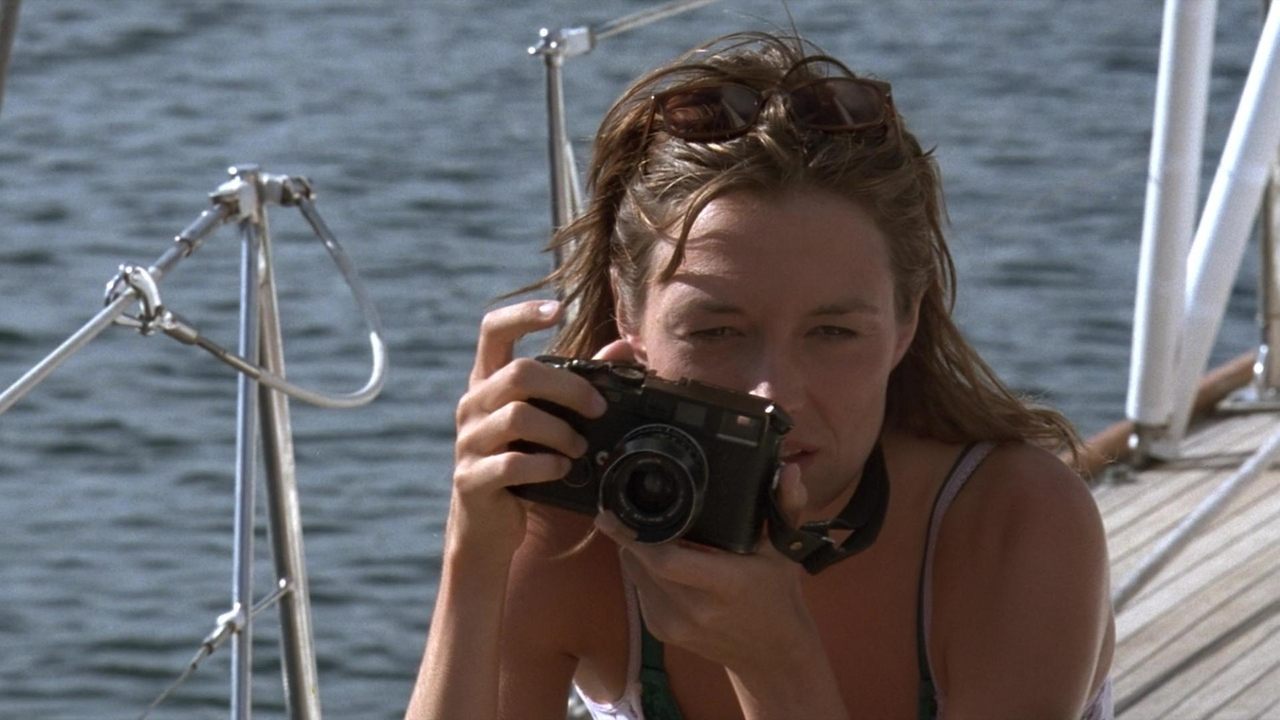
The premise itself is intriguing. We follow photojournalist Jean Janes (Catherine McCormack, bringing a compelling fragility) as she sails to the desolate Isles of Shoals off the New Hampshire coast. Her assignment: research the infamous Smuttynose Island murders of 1873, where two Norwegian immigrant women were brutally killed, and a third survived to accuse a man named Louis Wagner. Accompanying her are her celebrated poet husband Thomas (Sean Penn, radiating a familiar brand of intellectual brooding), his brother Rich (Josh Lucas), and Rich's enigmatic girlfriend Adaline (Elizabeth Hurley, cast somewhat against her usual type). As Jean delves deeper into the historical tragedy, the claustrophobic atmosphere aboard their yacht mirrors the simmering tensions of the past, forcing unsettling parallels to the surface. Doesn't the past always seem to whisper warnings to the present, if only we'd listen?
A Tale of Two Narratives

Bigelow, a director often associated with visceral action like Point Break (1991) or later, the gritty realism of The Hurt Locker (2008), takes a different tack here. The film excels in establishing atmosphere. The windswept, rocky isolation of the islands becomes a character itself, beautifully captured by cinematographer Adrian Biddle (who also shot Aliens (1986) and Thelma & Louise (1991)). The 19th-century flashbacks, focusing on the lonely lives of Maren Hontvedt (Sarah Polley, in a typically nuanced and affecting performance), her sister Karen (Katrin Cartlidge), and sister-in-law Anethe (Vinessa Shaw), are imbued with a palpable sense of hardship and simmering resentment. Polley, in particular, conveys volumes with just a glance, capturing the quiet desperation of a woman trapped by circumstance and emotion.
The challenge, however, lies in balancing these two threads. While the historical story feels vivid and emotionally resonant, the modern-day narrative sometimes struggles to match its intensity. The parallels – jealousy involving Thomas and Adaline echoing potential motives in the 1873 case – feel somewhat schematically drawn. We understand the idea of the connection, but the emotional weight doesn't always transfer effectively. Sean Penn delivers a solid performance as the self-absorbed artist, but the character feels slightly underwritten, making the central conflict less gripping than Maren's historical plight. Catherine McCormack does her best to anchor the present-day story, effectively portraying Jean's growing obsession and unease, but the script gives her less compelling material to work with compared to the historical tragedy she's uncovering.
Behind the Murky Waters
Adapting Shreve's complex novel, which relies heavily on internal monologue and ambiguity, was always going to be difficult. Writers Alice Arlen and Christopher Kyle manage to streamline the plot but perhaps lose some of the novel's psychological depth in the process. It's fascinating to note that the film premiered at the Toronto International Film Festival way back in September 2000 but faced significant distribution delays, only receiving a limited theatrical release in late 2002. This troubled path might reflect the film's own internal struggle – a potentially powerful story hampered by a slightly uneven execution. Filming took place primarily in Nova Scotia, convincingly standing in for the harsh beauty of the Isles of Shoals, and one can only imagine the logistical challenges Bigelow faced capturing those maritime scenes authentically. Despite its relatively modest $16 million budget, the film unfortunately failed to find an audience, grossing less than $200,000 worldwide – a stark reminder that critical acclaim for a source novel and a talented director don't always guarantee success.
The historical Smuttynose murders are, indeed, a real and chilling piece of New England history. The film, like the book, leans into the ambiguity surrounding Louis Wagner's guilt, suggesting Maren herself might have played a darker role. It's this ambiguity, this exploration of how desperation and isolation can curdle into violence, that forms the film's most potent core. What truly happens when people are pushed to their emotional limits in desolate places?
Final Reckoning
The Weight of Water is a film that leaves you with a lingering sense of melancholy rather than outright satisfaction. Its atmosphere is undeniable, the historical segments are often powerful, and Sarah Polley's performance is a standout. However, the modern-day storyline feels less developed, preventing the intended thematic resonance from fully landing. It feels like a film reaching for profundity but getting caught somewhere in the murky depths between its two narratives. It’s a respectable, often beautifully crafted piece, but one that doesn’t quite achieve the haunting power it seems to promise. It arrived at a transitional moment, perhaps too late for the heyday of VHS rentals where contemplative dramas could more easily find their niche, and maybe a bit too soon for the streaming era's embrace of complex narratives.
Rating: 6/10
This score reflects the film's undeniable strengths in atmosphere, direction, and the compelling historical narrative, particularly Polley's performance. However, it's held back by the less convincing modern-day plotline and the somewhat forced parallels, which prevent it from reaching its full potential.
It's a film that makes you think about the echoes of the past and the destructive nature of jealousy, even if it doesn't quite make you feel the connection as strongly as it intends. Worth a watch, especially for fans of Bigelow's range or historical mysteries, but temper expectations for a perfectly resolved emotional journey. What lingers isn't necessarily the plot's conclusion, but the cold, windswept feeling of isolation it so effectively evokes.